Within Stigma
Did Project Blue Book Create the Stigma?
Project Blue Book helped shape a public split between official dismissal and lasting UFO suspicion.
On this page
- What Blue Book concluded
- Why closure did not end public interest
- How official discouragement fed distrust
Page outline Jump by section
Introduction
Project Blue Book did not create public interest in unidentified flying objects (UFOs), but it played a major role in shaping the modern social stigma around them. Between 1952 and 1969, the programme became the United States Air Force’s primary public investigation into UFO reports. When it closed, officials concluded that there was no evidence that the investigated cases represented a national security threat, advanced unknown technology, or extraterrestrial vehicles. Those conclusions became the official public narrative for decades.[Air Force]af.milAir ForceUnidentified Flying Objects and Air Force Project Blue Bookthe conclusions of Project Blue Book were: No UFO reported, investiga…
 Yet the programme’s legacy proved more complicated than its final statement. While the Air Force regarded Blue Book as evidence that further investigation was unnecessary, many members of the public interpreted the government’s dismissive tone as evidence that something was being concealed. This divide helped establish a lasting cultural pattern: official scepticism on one side, persistent public suspicion on the other. That historical backdrop remains important when considering why celebrities discussing UFOs can still seem unusually influential. They are often entering a conversation shaped as much by institutional history as by the sightings themselves.
Did Project Blue Book create the stigma?
Project Blue Book did not invent scepticism, but it institutionalised an official approach that treated most reports as explainable and increasingly discouraged the subject from being viewed as a serious scientific or military problem.
Blue Book itself evolved from earlier Air Force investigations, including Projects Sign and Grudge, during a period of Cold War anxiety about both Soviet technology and public panic. The Air Force’s primary mission was never to prove or disprove extraterrestrial life. Rather, it sought to determine whether reported objects represented hostile aircraft or other national security concerns.[Air Force]af.milAir ForceUnidentified Flying Objects and Air Force Project Blue Bookthe conclusions of Project Blue Book were: No UFO reported, investiga…
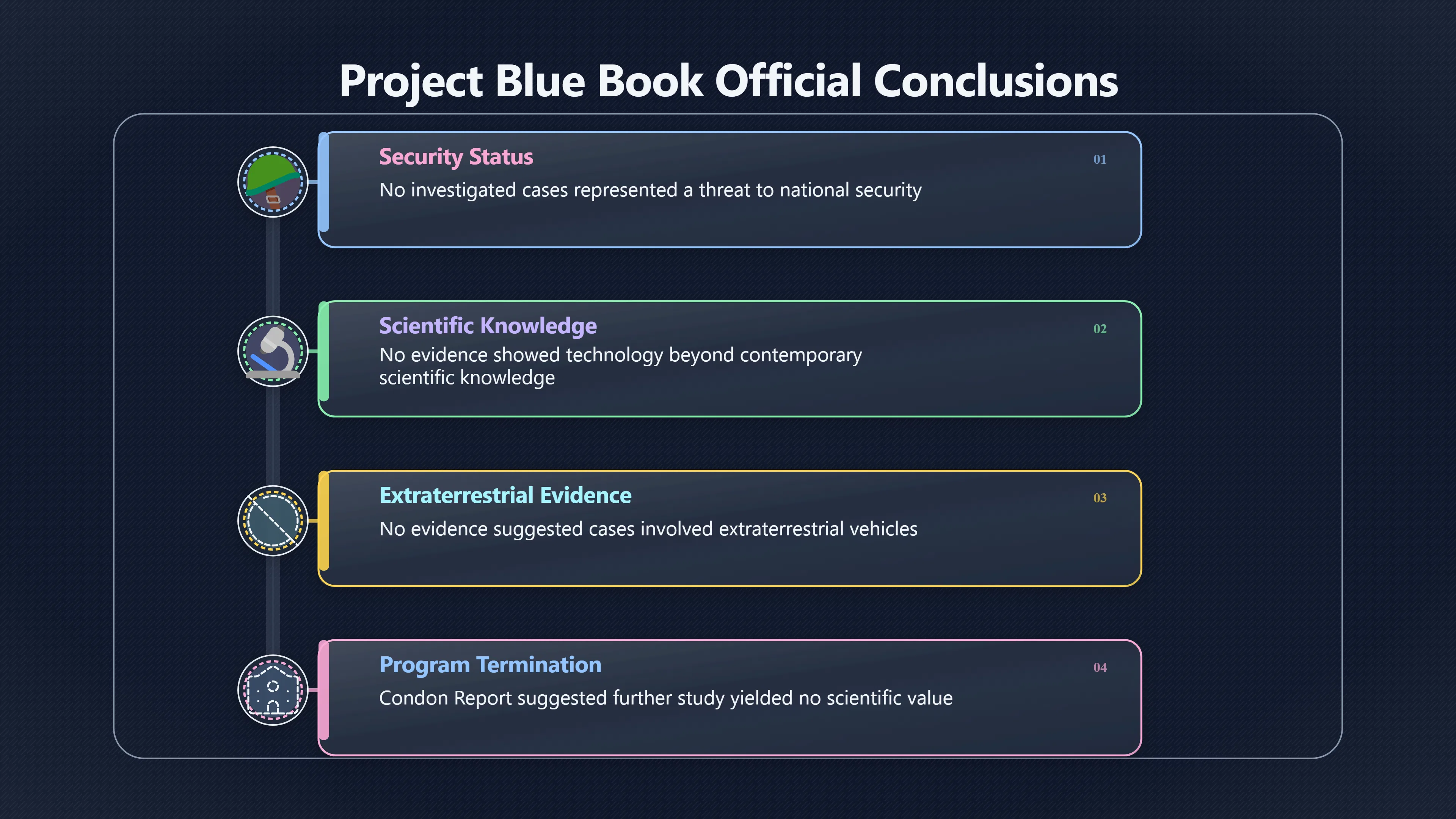
By the programme’s end, the Air Force announced three headline conclusions:
- no investigated UFO represented a threat to national security;
- there was no evidence of technology beyond contemporary scientific knowledge;
- there was no evidence that investigated cases involved extraterrestrial vehicles.[Air Force]af.milAir ForceUnidentified Flying Objects and Air Force Project Blue Bookthe conclusions of Project Blue Book were: No UFO reported, investiga…
These conclusions became widely quoted in media coverage and helped establish the idea that official investigation had settled the matter. However, the existence of 701 cases remaining officially “unidentified” also ensured that Blue Book never fully resolved public curiosity. Those unresolved cases were interpreted very differently by sceptics and believers.[Air Force]af.milAir ForceUnidentified Flying Objects and Air Force Project Blue Bookthe conclusions of Project Blue Book were: No UFO reported, investiga…
What Blue Book concluded
Blue Book investigated 12,618 reported sightings between 1947 and 1969 (including records inherited from earlier projects), classifying the overwhelming majority as conventional phenomena such as aircraft, balloons, astronomical objects, weather effects or hoaxes. Approximately five per cent remained unexplained after investigation.[Air Force]af.milAir ForceUnidentified Flying Objects and Air Force Project Blue Bookthe conclusions of Project Blue Book were: No UFO reported, investiga…
Importantly, “unidentified” did not mean “alien”. It meant investigators could not confidently determine the cause from the available evidence. The Air Force argued that unresolved cases reflected incomplete information rather than proof of extraordinary technology.[Air Force]af.milAir ForceUnidentified Flying Objects and Air Force Project Blue Bookthe conclusions of Project Blue Book were: No UFO reported, investiga…
The decision to terminate Blue Book relied heavily on the University of Colorado’s 1968 Scientific Study of Unidentified Flying Objects, commonly known as the Condon Report. After review by the National Academy of Sciences, the Air Force concluded that continued large-scale investigation was unlikely to produce scientifically valuable discoveries and therefore ended the programme in December 1969.[Air Force]af.milAir ForceUnidentified Flying Objects and Air Force Project Blue Bookthe conclusions of Project Blue Book were: No UFO reported, investiga…
Why closure did not end public interest
If Blue Book was intended to settle the question, it largely failed to do so.[Wikipedia]WikipediaProject Blue BookProject Blue BookCondon Report, which concluded that the study of UFOs was unlikely to yield major scientific discoveries, Project Blu…
One reason is that the programme’s public conclusions and its internal history appeared more complicated than the official summary suggested. Researchers later examined declassified files, disagreements among investigators and changing opinions of participants such as astronomer J. Allen Hynek. Hynek initially joined as a sceptical scientific consultant but later argued that a small minority of cases deserved more rigorous scientific attention and criticised the tendency to dismiss reports too quickly.[Popular Mechanics]popularmechanics.comAllen Hynek from a government consultant and UFO skeptic into the foremost advocate for serious scientific study of unidentified flying o…
Another factor was the persistence of unexplained cases. For sceptics, these simply reflected insufficient data. For many UFO researchers, however, the remaining unexplained files demonstrated that Blue Book had not actually solved the phenomenon.
The programme’s closure also coincided with growing public distrust of government institutions during the late 1960s and early 1970s. In that broader political climate, official reassurance sometimes produced the opposite reaction: rather than reducing suspicion, it encouraged some observers to believe that important information was being withheld.
How official discouragement fed distrust
The roots of UFO stigma extend beyond Blue Book itself to broader Cold War policy.[Wikipedia]WikipediaProject Blue BookProject Blue BookCondon Report, which concluded that the study of UFOs was unlikely to yield major scientific discoveries, Project Blu…
Following the highly publicised Washington, DC sightings of 1952, the CIA convened the Robertson Panel in 1953 to review the issue. The panel concluded that most reports probably had conventional explanations and expressed concern that excessive public attention could overload military reporting systems or be exploited during periods of national emergency. It recommended reducing public fascination through educational and public-information efforts rather than expanding investigation.[Wikipedia]WikipediaRobertson PanelRobertson Panel
Historians disagree about how extensively these recommendations shaped later Air Force practice. However, there is broad agreement that official policy increasingly emphasised reducing public concern instead of encouraging widespread scientific engagement with the topic. Critics argue this contributed to making UFO reports appear professionally embarrassing, while defenders argue it reflected practical Cold War priorities rather than an attempt to suppress genuine discoveries.[Wikipedia]WikipediaRobertson PanelRobertson Panel
This distinction matters. The historical evidence supports the claim that government agencies sought to lower public interest in UFO reports under certain Cold War conditions. It does not support the stronger claim that Project Blue Book itself was created to hide evidence of extraterrestrial spacecraft.
Blue Book’s lasting influence on today’s UAP debate
Modern discussion increasingly uses the term “unidentified anomalous phenomena” (UAP) rather than UFO, partly to avoid decades of cultural baggage attached to the older label. Even so, Blue Book remains the historical reference point against which new official investigations are judged.
When governments today announce investigations into UAP, supporters often argue that officials have finally become more open than they were during the Blue Book era. Sceptics, by contrast, frequently point to Blue Book’s conclusions as evidence that extraordinary claims have repeatedly failed to withstand systematic investigation.
This historical divide also explains why celebrity testimony attracts attention disproportionate to its evidential value. In a cultural environment where many people still associate official institutions with dismissal, well-known public figures can make discussion seem socially acceptable even though their personal accounts do not change the underlying evidence. The continuing influence of Project Blue Book is therefore less about what it proved than about the lasting relationship it created between official reassurance, public distrust and the social stigma surrounding UFO reports.
Amazon book picks
Further Reading
Books and field guides related to Did Project Blue Book Create the Stigma?. Use these as the next step if you want deeper reading beyond the article.
The Report on Unidentified Flying Objects
Firsthand account closely tied to Project Blue Book.

UFOs : Generals, Pilots, and Government Officials Go on the R...
Places official investigations into modern context.
eBay marketplace picks
Marketplace Samples
Live-tested eBay searches with available results related to this page.


Endnotes
1.
Source: Wikipedia
Title: Project Sign
Link:https://en.wikipedia.org/wiki/Project_Sign
2.
Source: Wikipedia
Title: The Report on Unidentified Flying Objects
Link:https://en.wikipedia.org/wiki/The_Report_on_Unidentified_Flying_Objects
3.
Source: Wikipedia
Title: Robertson Panel
Link:https://en.wikipedia.org/wiki/Robertson_Panel
4.
Source: cia.gov
Link:https://www.cia.gov/readingroom/document/0005517742
Source snippet
hout the 1950s and 1960s.8. Robertson panel report on UFOs...
5.
Source: Wikipedia
Title: Project Blue Book
Link:https://en.wikipedia.org/wiki/Project_Blue_Book
Source snippet
Project Blue BookCondon Report, which concluded that the study of UFOs was unlikely to yield major scientific discoveries, Project Blu...
6.
Source: war.gov
Link:https://www.war.gov/medialink/ufo/061226/release_03/documents/CIA-UAP-015-Project_Blue_Book_Special_Report_No_14.pdf
7.
Source: youtube.com
Link:https://www.youtube.com/watch?v=1cO5K1np2Ig
Source snippet
Project Blue Book...
8.
Source: youtube.com
Title: Project Blue Book
Link:https://www.youtube.com/watch?v=jjinS2lZAsY
Source snippet
'Project Blue Book' Ep. 1 Official Clip | UFO | SHOWTIME Documentary Series...
9.
Source: af.mil
Link:https://www.af.mil/About-Us/Fact-Sheets/Display/Article/104590/unidentified-flying-objects-and-air-force-project-blue-book/
Source snippet
Air ForceUnidentified Flying Objects and Air Force Project Blue Bookthe conclusions of Project Blue Book were: No UFO reported, investiga...
10.
Source: popularmechanics.com
Link:https://www.popularmechanics.com/military/a70995826/j-allen-hynek-project-blue-book-ufo-investigation-truth/
Source snippet
Allen Hynek from a government consultant and UFO skeptic into the foremost advocate for serious scientific study of unidentified flying o...
Additional References
11.
Source: nsa.gov
Link:https://www.nsa.gov/portals/75/documents/news-features/declassified-documents/ufo/usaf_fact_sheet_95_03.pdf
Source snippet
FO reported, investigated and evaluated by the Air Force was ever an indication of threat to our national...
12.
Source: theoriesofanything.com
Link:https://theoriesofanything.com/research/project-blue-book-history-and-legacy
Source snippet
t (University of Colorado, 1969), which concluded that further study of UFOs was...
13.
Source: youtube.com
Title: They Spent 70 Years Making You Laugh at UFOs, Here’s Why | Al Maghrib Podcast
Link:https://www.youtube.com/watch?v=DBs5r6_z6dU
Source snippet
The impact of disclosure: John Priestland, Dr. Martin Abbas on psychology of contact | Reality Check...
14.
Source: youtube.com
Title: ‘Project Blue Book’ Ep. 1 Official Clip | UFO | SHOWTIME Documentary Series
Link:https://www.youtube.com/watch?v=W89jh2C2Ry8
Source snippet
They Spent 70 Years Making You Laugh at UFOs, Here's Why | Al Maghrib Podcast...
15.
Source: archives.gov
Title: National Archives Project BLUE BOOK
Link:https://www.archives.gov/research/military/air-force/ufos
Source snippet
The project closed in 1969 and we have no...Read more...
16.
Source: esd.whs.mil
Link:https://www.esd.whs.mil/Portals/54/Documents/FOID/Reading%20Room/UFOsandUAPs/2d_af_1.pdf
Source snippet
Defense Logistics AgencyThe Air Force investigation of UFO's began in 1948 and...the conclusions of Project Blue Book were: (1) no UFO r...
17.
Source: youtube.com
Link:https://www.youtube.com/watch?v=z0_ZLCh1jBI
Topic Tree