Within Advocacy
Why pilots stay quiet about UFO sightings
Fear of ridicule can stop pilots from reporting strange aerial encounters, leaving investigators with weaker data than the event deserves.
On this page
- Why stigma damages the evidence record
- What safer reporting systems can and cannot fix
- How to separate witness respect from proof
Page outline Jump by section
Introduction
One of the strongest arguments made by serious investigators of unidentified aerial phenomena (UAP), formerly more commonly called UFOs, is not that pilots are uniquely reliable witnesses or that unusual reports prove extraordinary claims. It is that fear of ridicule and professional consequences can discourage experienced aviation personnel from reporting unusual observations at all. If that happens, potentially valuable safety information is lost before it can be examined.
 This matters because aviation depends on accurate reporting. Pilots are expected to report weather hazards, equipment failures, near misses and other unexpected events. When unusual aerial observations are treated differently because of cultural stigma rather than their possible safety relevance, the evidence record becomes incomplete. At the same time, reducing stigma should not be confused with lowering evidential standards. Encouraging reports improves the quantity of data available for investigation; it does not establish that any particular sighting represents extraterrestrial technology or any other specific explanation. NASA’s independent UAP study and other official reviews make precisely this distinction, arguing for better reporting while also concluding that there is no verified evidence that reported UAP are of extraterrestrial origin.[NASA Science+2WIRED]science.nasa.govNASA ScienceIndependent Study Team ReportAviation Safety Reporting System. This confi- dential and voluntary reporting system for pilots…
Why stigma damages the evidence record
The problem is not simply that some reports are never filed. Stigma changes which reports survive, what details are recorded and how quickly evidence can be collected.
In aviation, timing matters. Radar data may be overwritten, cockpit recordings may not be preserved indefinitely, and weather or traffic information becomes harder to reconstruct as time passes. A pilot who hesitates to report an unusual event because they expect mockery or professional scrutiny may unintentionally reduce the quality of any later investigation.
NASA’s 2023 independent study identified stigma as a practical obstacle to obtaining scientifically useful observations. The report argued that people who fear ridicule are less likely to report events, reducing the amount of high-quality data available for analysis. Rather than treating UAP as a special category requiring extraordinary procedures, the study recommended incorporating reports into established aviation safety systems that already encourage confidential reporting of unexpected events.[NASA Science]science.nasa.govNASA ScienceIndependent Study Team ReportAviation Safety Reporting System. This confi- dential and voluntary reporting system for pilots…
This creates a feedback loop:
- Fewer reports produce smaller datasets.
- Smaller datasets make patterns harder to detect.
- Limited evidence reinforces scepticism that reporting is worthwhile.
- Continued silence leaves investigators with the same lack of information.
Importantly, this mechanism affects ordinary explanations as well as extraordinary ones. An unreported object could later prove to have been a balloon, drone, sensor artefact or atmospheric phenomenon, but investigators cannot determine that if no report exists.
Why pilots may choose not to report
Commercial and military pilots operate in professions where judgement is constantly evaluated. Even when reporting procedures formally protect employees, informal workplace culture can influence behaviour.
Common concerns include:
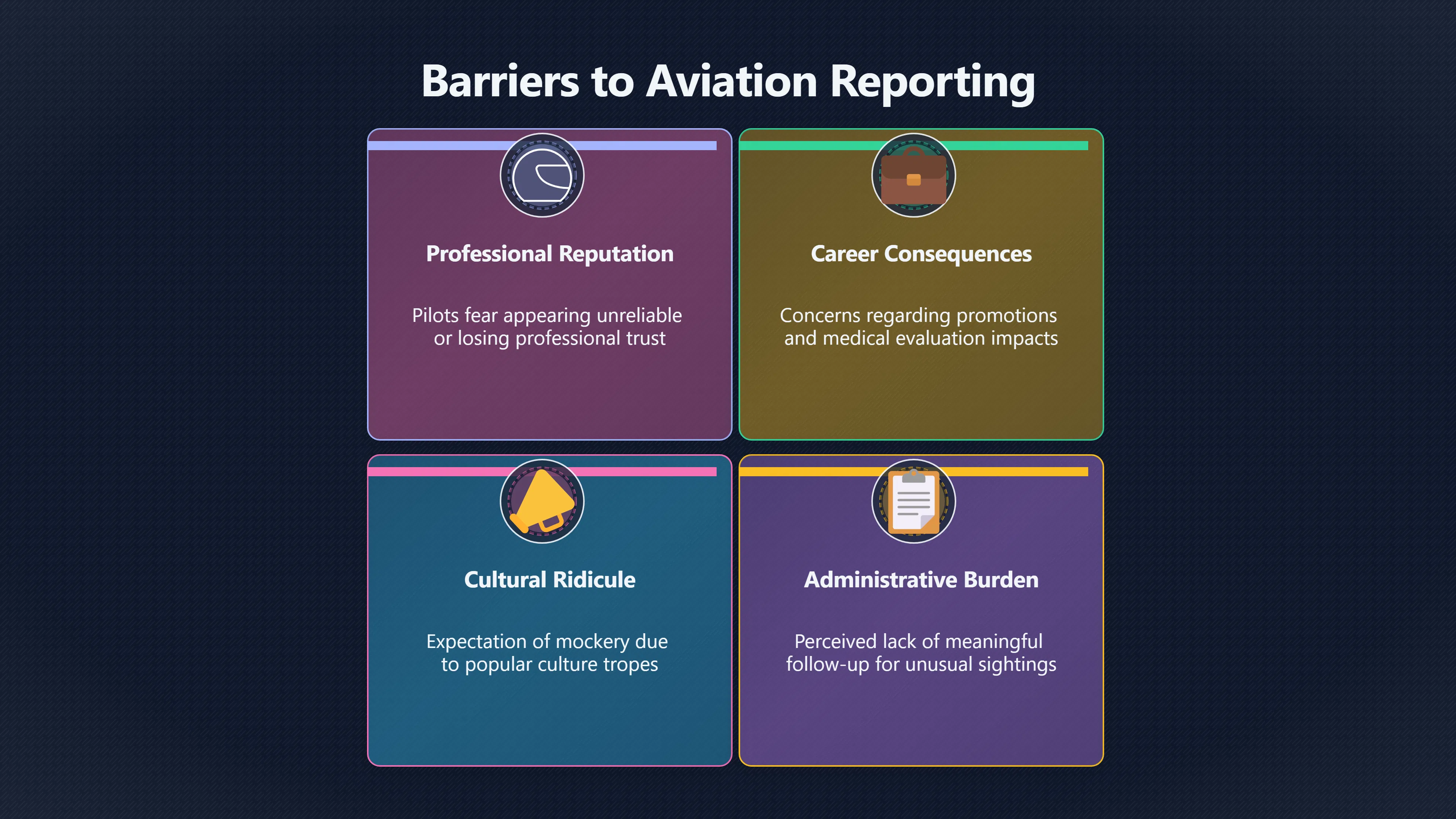
- Fear of appearing unreliable. Pilots are trusted because they are expected to distinguish accurately between routine and unusual events. Some worry that discussing unexplained observations could damage that perception.
- Career consequences. Although evidence for systematic punishment is limited, many pilots have described concerns that unusual reports could affect promotions, medical evaluations or professional reputation.
- Expectation of ridicule. The long association between “UFOs” and popular culture means some aviation personnel assume their observations will be dismissed before investigation begins.
- Administrative burden. If reporting seems unlikely to produce meaningful follow-up, pilots may conclude that the effort is not worthwhile.
During NASA’s public discussions of its UAP study, panel chair David Spergel noted that commercial pilots had been particularly reluctant to report unusual sightings because of the stigma attached to the subject. Reuters reported similar concerns, contrasting the more formal reporting available to military aviators with the hesitancy often found in commercial aviation.[GovTech+2Reuters]govtech.comnasa publicly discusses its new study about ufos“One of our goals is to…Read more…

What safer reporting systems can and cannot fix
The recent shift from “UFO” to “UAP” reflects more than a change in terminology. Many organisations have tried to frame unexplained observations primarily as an aviation safety issue rather than an argument about alien visitors.
NASA pointed to the existing Aviation Safety Reporting System (ASRS) as an example of a confidential, voluntary reporting framework that already supports aviation safety. Such systems encourage personnel to report unusual events without assuming that every report reflects a serious hazard or an extraordinary phenomenon.[NASA Science]science.nasa.govNASA ScienceIndependent Study Team ReportAviation Safety Reporting System. This confi- dential and voluntary reporting system for pilots…
Similarly, the Pentagon’s All-domain Anomaly Resolution Office (AARO) encourages civilian pilots to report unusual observations through normal air traffic control channels, with reports reaching AARO through established Federal Aviation Administration processes.[AARO]aaro.milAARO HomeHow can I share information with AARO or report a UAP?… AARO receives UAP-related Pilot Reports (PIREPs) from the Federal…
Supporters of improved reporting argue that these approaches provide several advantages:
- They normalise reporting as part of ordinary flight safety.
- They preserve evidence sooner after an event.
- They allow investigators to compare reports with radar, weather and other operational data.
- They reduce pressure on individual witnesses to defend extraordinary interpretations.
However, better reporting systems have clear limits.
They cannot guarantee accurate observations. Human perception remains fallible, especially during brief encounters involving unfamiliar objects, night flying or complex atmospheric conditions. Nor can confidential reporting transform anecdotal accounts into proof of any particular explanation. Better systems improve the quality of evidence available for investigation; they do not predetermine what investigators will conclude.
How to separate witness respect from proof
A common misunderstanding in public debates is that respecting a pilot automatically means accepting their interpretation.
These are separate questions.
Professional pilots often make excellent observational witnesses because they have extensive experience identifying aircraft, judging motion and operating in complex airspace. Their reports therefore deserve careful documentation rather than automatic dismissal.
Yet expertise has limits. Even highly trained observers can misidentify unfamiliar objects under unusual viewing conditions, particularly when visual cues are limited or when multiple sensor systems produce incomplete information. Aviation history contains many examples of experienced crews initially misunderstanding weather phenomena, optical effects or technical malfunctions before later evidence clarified what had happened.
The scientific approach therefore asks two questions simultaneously:
- Was the witness credible and sincere?
- Does independent evidence support the proposed explanation?
A positive answer to the first question does not automatically answer the second.
This distinction explains why NASA simultaneously argued for reducing reporting stigma while concluding that existing public evidence does not demonstrate extraterrestrial technology. Likewise, AARO has reported that many investigated cases have ultimately been resolved as balloons, aircraft, drones, satellites, birds or other conventional objects, while acknowledging that some cases remain unresolved because available data are insufficient rather than because they demonstrate non-human technology. NASA Science+2U.S. Department of War[science.nasa.gov]science.nasa.govNASA ScienceIndependent Study Team ReportAviation Safety Reporting System. This confi- dential and voluntary reporting system for pilots…
Why this matters in debates about UFO advocacy
Within the broader discussion of UFO advocacy, pilot stigma is one of the strongest examples of where advocacy can make a practical contribution without proving extraordinary claims.
Former naval aviators such as Ryan Graves have argued that removing stigma encourages reporting of potential aviation hazards regardless of their eventual explanation. That position does not require investigators to conclude that unusual sightings involve alien spacecraft. Instead, it treats unexplained observations as events worthy of documentation because unexplained does not necessarily mean insignificant.[Aviation Week]aviationweek.compodcast understanding uap aerospace safety concernAviation WeekUnderstanding UAP As An Aerospace Safety Concern25 Oct 2024 — Former F/A-18 pilot Ryan Graves who leads Americans for Safe A…
Seen this way, reducing stigma serves a limited but important purpose. It can improve the completeness of the evidence available to investigators, preserve information that might otherwise disappear, and strengthen aviation safety processes. Whether individual reports ultimately prove to involve ordinary objects, sensor errors or genuinely unresolved phenomena remains a separate question that depends on the evidence gathered after the report is made.
Amazon book picks
Further Reading
Books and field guides related to Why pilots stay quiet about UFO sightings. Use these as the next step if you want deeper reading beyond the article.

UFOs : Generals, Pilots, and Government Officials Go on the R...
Includes pilot testimony while emphasizing documentation and investigation.
Skunk Works
Provides aviation and defense context that complements discussion of unusual sightings.
The Demon-Haunted World: Science as a Candle in the Dark
Supports the distinction between respecting witnesses and proving claims.
eBay marketplace picks
Marketplace Samples
Live-tested eBay searches with available results related to this page.



Endnotes
1.
Source: science.nasa.gov
Link:https://science.nasa.gov/wp-content/uploads/2023/09/uap-independent-study-team-final-report.pdf
Source snippet
NASA ScienceIndependent Study Team ReportAviation Safety Reporting System. This confi- dential and voluntary reporting system for pilots...
2.
Source: wired.com
Link:https://www.wired.com/story/nasa-ufos-aliens-report-2023
Source snippet
The agency stressed the need to shift the conversation from sensationalism to science and eliminate the stigma associated with reporting...
3.
Source: govtech.com
Title: nasa publicly discusses its new study about ufos
Link:https://www.govtech.com/products/nasa-publicly-discusses-its-new-study-about-ufos
Source snippet
“One of our goals is to...Read more...
4.
Source: reuters.com
Title: nasa panel hold first public meeting ufo study ahead report 2023 05 31
Link:https://www.reuters.com/world/us/nasa-panel-hold-first-public-meeting-ufo-study-ahead-report-2023-05-31/
Source snippet
NASA UFO panel in first public meeting says better data...1 Jun 2023 — military aviators to document UAP events, many commercial pilots...
5.
Source: aaro.mil
Link:https://www.aaro.mil/
Source snippet
AARO HomeHow can I share information with AARO or report a UAP?... AARO receives UAP-related Pilot Reports (PIREPs) from the Federal...
6.
Source: war.gov
Title: dr jon kosloski director aaro media roundtable on the fy24 consolidated annual
Link:https://www.war.gov/News/Transcripts/Transcript/Article/3965734/dr-jon-kosloski-director-aaro-media-roundtable-on-the-fy24-consolidated-annual/
Source snippet
Department of WarDr. Jon Kosloski, Director, AARO, Media Roundtable on the...This week, the department delivered its Fiscal Year 2024 co...
7.
Source: science.nasa.gov
Link:https://science.nasa.gov/uap/
Source snippet
nasa.govUAP9 Jun 2022 — The study will focus on identifying available data, how best to collect future data, and how NASA can use that da...
8.
Source: war.gov
Title: dod examining unidentified anomalous phenomena
Link:https://www.war.gov/News/News-Stories/Article/Article/3965403/dod-examining-unidentified-anomalous-phenomena/
Source snippet
14 Nov 2024 — This report covers UAP from May 1, 2023, to June 1, 2024, and all UAP reports from any previous time periods that were not...
Published: May 1, 2023
9.
Source: war.gov
Title: department of defense releases the annual report on unidentified anomalous phen
Link:https://www.war.gov/News/Releases/Release/Article/3964824/department-of-defense-releases-the-annual-report-on-unidentified-anomalous-phen/
Source snippet
Department of Defense Releases the Annual Report on...14 Nov 2024 — This year's UAP report covers UAP reports from May 1, 2023, to June...
Published: May 1, 2023
10.
Source: aaro.mil
Link:https://www.aaro.mil/Portals/136/PDFs/AARO_Mission_Brief_2025.pdf
Source snippet
The US Defense Department & The UAP MissionCivilian pilots are encouraged to promptly report UAP sightings to air traffic control. AARO r...
11.
Source: aviationweek.com
Title: podcast understanding uap aerospace safety concern
Link:https://aviationweek.com/podcasts/check-6/podcast-understanding-uap-aerospace-safety-concern
Source snippet
Aviation WeekUnderstanding UAP As An Aerospace Safety Concern25 Oct 2024 — Former F/A-18 pilot Ryan Graves who leads Americans for Safe A...
Additional References
12.
Source: linkedin.com
Link:https://www.linkedin.com/posts/uap-coalitie-nederland_uap-aviationsafety-justculture-activity-7369096395246473221-rDGB
Source snippet
#uap #aviationsafety #justculture #pilots #aviation #easa #euCentralized Reporting: The paper proposes using the NASA Aviation Safety Rep...
13.
Source: aui.edu
Link:https://aui.edu/aaro-releases-report-on-unidentified-anomalous-phenomena-uap/
Source snippet
AARO Releases Report on Unidentified Anomalous...The report details key findings from the workshop conducted at AUI headquarters in Augu...
14.
Source: aiaa.org
Link:https://aiaa.org/wp-content/uploads/2025/08/AIAA-UAPIOC-Opinion-Paper-UAP-Occupational-Safety-Reporting_ForPublication_kb.pdf
Source snippet
ADDRESSING THE UNKNOWN:This opinion paper uses existing aviation safety principles to present a framework organized around five key consi...
15.
Source: elitefasion.com
Link:https://elitefasion.com/uap-ufo-records/nasa-asrs-uap-reporting
Source snippet
NASA ASRS, Stigma, and Better UAP Reporting | Elite FashionRead NASA ASRS, Stigma, and Better UAP Reporting from Elite Fashion, with clea...
16.
Source: reddit.com
Link:https://www.reddit.com/r/space/comments/16ij6ui/nasa_shares_unidentified_anomalous_phenomena/
Source snippet
NASA Shares Unidentified Anomalous Phenomena...I read the report. To summarize: we should reduce stigma for reporting this stuff. we nee...
17.
Source: majorcitieschiefs.com
Link:https://majorcitieschiefs.com/wp-content/uploads/2024/06/MCCA-UAP_Reference-Guide-June-2024-.pdf
Source snippet
Reference GuideMany reports by pilots and aviation professionals of observations and incidents involving UAP include aviation safety fact...
18.
Source: safeaerospace.org
Link:https://www.safeaerospace.org/
19.
Source: linkedin.com
Link:https://www.linkedin.com/posts/national-aviation-reporting-center-on-anomalous-phenomena-narcap_airufocldoc-activity-7142240933776867328-8K6t
Source snippet
National Aviation Reporting Center on Anomalous...17 Dec 2023 — NARCAP has been studying UAP effects on aviation safety since 1999. Our...
20.
Source: safeaerospace.org
Link:https://www.safeaerospace.org/news/why-don-t-pilots-report-what-they-see-understanding-the-career-risks-behind-uap-reporting
Source snippet
Why Don't Pilots Report What They See? Understanding...6 Jan 2026 — Our new white paper documents the regulatory framework that keeps 90...
21.
Source: hstoday.us
Link:https://www.hstoday.us/subject-matter-areas/intelligence/director-of-national-intelligence-submits-annual-report-on-unidentified-aerial-phenomena/
Source snippet
Director of National Intelligence Submits Annual Report on...12 Jan 2023 — Unidentified Aerial Phenomena (UAP) reporting is increasing...
Topic Tree