Within Story Spread
Why famous witnesses feel more believable
Familiar public figures can make ambiguous UFO anecdotes feel more personal, memorable, and worth sharing.
On this page
- How parasocial familiarity changes first impressions
- Why sincerity can substitute for hard evidence
- Where celebrity trust breaks down
Page outline Jump by section
Introduction
Celebrity UFO stories often spread faster than similar claims from unknown witnesses because many audiences already feel they know the person telling the story. Media researchers describe these one-sided emotional bonds as parasocial relationships: a sense of familiarity built through years of watching films, listening to music, following interviews or engaging on social media. When a celebrity describes an unusual experience, that existing relationship can make the account feel more personal, sincere and memorable before any evidence has been examined. This does not make the claim more accurate, but it changes how people initially evaluate it. In UFO discussions, where many reports are inherently ambiguous, that shift in first impressions can have a powerful effect on how stories are shared and remembered.[Wikipedia]WikipediaParasocial interactionParasocial interaction
How parasocial familiarity changes first impressions
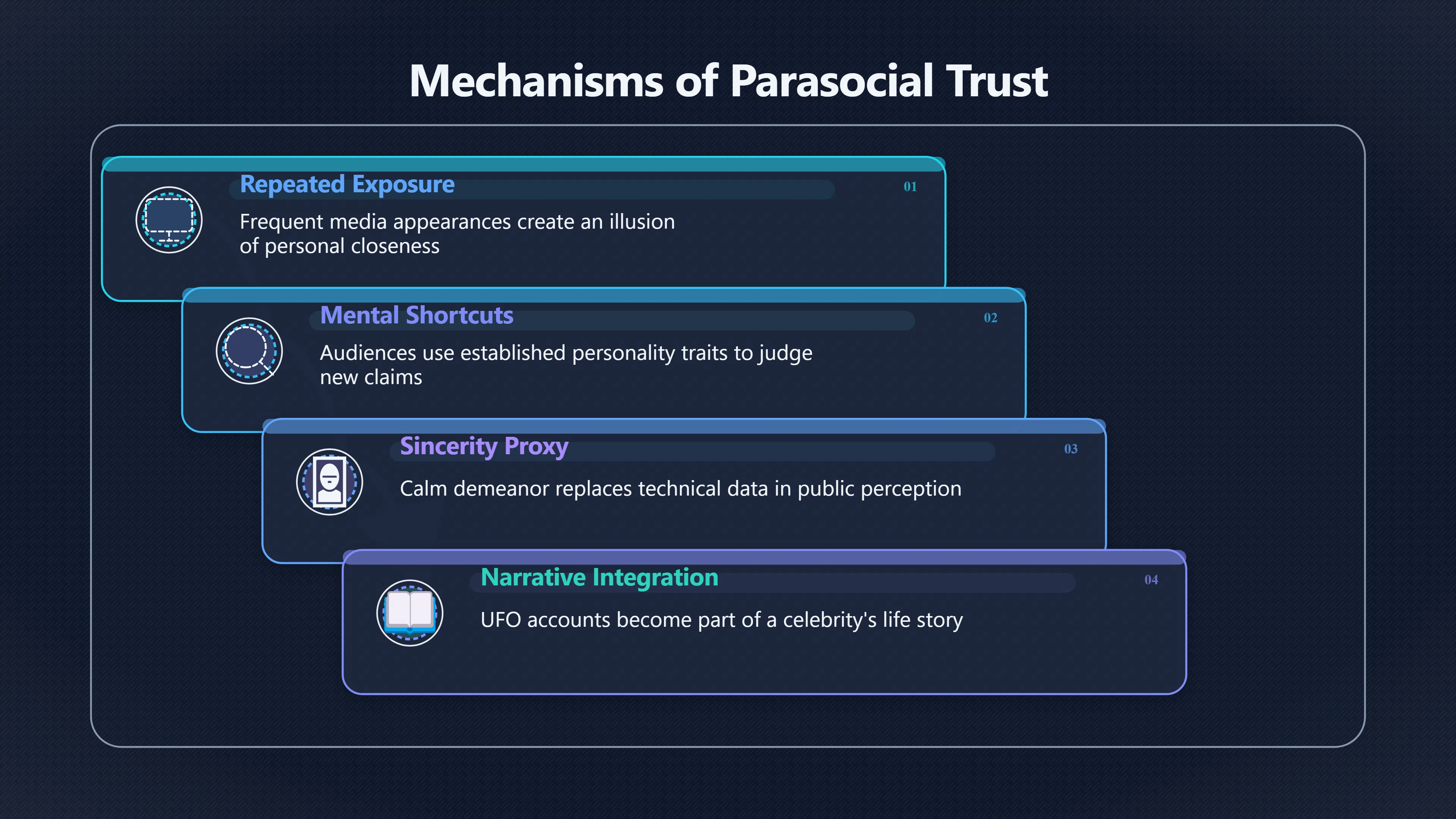
Parasocial trust works because people rarely encounter celebrity testimony as if it came from a stranger. Fans often carry years of accumulated impressions about a public figure’s personality, humour, honesty and behaviour. Those impressions become mental shortcuts when evaluating an unexpected claim.
Communication researchers have argued since Horton and Wohl introduced the concept in 1956 that repeated media exposure creates an illusion of social familiarity. Modern research extends this finding into digital media, showing that perceived closeness can increase trust, engagement and the willingness to treat a celebrity’s statements as personally meaningful rather than merely informational.[Wikipedia]WikipediaParasocial interactionParasocial interaction
In the context of UFO reports, this familiarity changes the opening question. Instead of asking only, “Did this event happen?”, audiences often begin with, “Would this person invent such a story?” That subtle shift matters because sincerity is easier for most people to judge intuitively than technical evidence involving radar returns, astronomical explanations or sensor data.
The effect is strongest when the celebrity’s public image has remained relatively consistent over many years. Long-term familiarity can produce a sense that listeners are evaluating the testimony of an acquaintance rather than a distant public figure, even though the relationship exists only through media exposure.
Why sincerity can substitute for hard evidence
Many celebrity UFO accounts rely primarily on personal recollection rather than independently verifiable physical evidence. In these situations, audiences often evaluate the witness’s perceived character alongside the claim itself.
Psychological research on credibility consistently finds that people use heuristics—mental shortcuts—when complete information is unavailable. Apparent honesty, emotional consistency and lack of obvious financial motivation may therefore become proxies for reliability. A celebrity who appears calm and matter-of-fact describing an unusual sighting can seem persuasive despite offering little objective evidence.[Wikipedia]WikipediaParasocial interactionParasocial interaction
This helps explain why some celebrity UFO stories remain culturally influential despite limited supporting documentation.
- John Lennon gave unusual longevity to his reported 1974 sighting by mentioning it directly in the artwork accompanying Walls and Bridges. Because the claim became attached to an authentic artefact from one of popular music’s best-known figures, fans repeatedly encounter it within the broader story of his life rather than as an isolated UFO report.
- Kurt Russell’s account gained attention because he described unexpectedly realising years later that he had apparently been the pilot who reported mysterious lights during the events later associated with the Phoenix Lights. The story’s appeal rests largely on his reputation as an apparently reluctant witness rather than on new physical evidence.
- Tom DeLonge illustrates a different version of the mechanism. His long-running public interest in UFOs means supporters often interpret new statements within an existing narrative of commitment and sincerity, while critics interpret the same history as evidence of confirmation bias. The same parasocial relationship therefore strengthens belief for some audiences and scepticism for others.
In each example, the witness’s established public identity becomes part of the evidence people believe they are evaluating, even though personal familiarity cannot independently verify extraordinary claims.
Where celebrity trust breaks down
Parasocial trust has important limits. Familiarity encourages attention, but it does not eliminate critical scrutiny.
The mechanism weakens when audiences perceive obvious incentives such as promoting a new project, cultivating controversy or reinforcing an established public persona. Once listeners suspect commercial or reputational motivations, the same familiarity that initially encouraged trust may instead encourage scepticism.
Trust also becomes fragmented because celebrities have diverse audiences. Fans who already admire a performer may interpret an unusual story as authentic vulnerability, whereas critics may interpret identical behaviour as attention-seeking. Parasocial relationships amplify existing attitudes rather than producing universal belief.
Institutional investigations illustrate another limit. Organisations examining unidentified aerial phenomena emphasise that witness testimony alone is insufficient for strong conclusions. NASA’s Independent Study Team concluded that most UAP cases suffer from incomplete or poorly calibrated data and argued that higher-quality observations are needed for scientific assessment. Similarly, the US Department of Defense’s All-domain Anomaly Resolution Office has repeatedly stated that it has found no verified evidence of extraterrestrial technology or activity in the cases it has reviewed. These assessments do not judge whether individual witnesses are sincere; they distinguish sincerity from evidential strength.[arXiv]arxiv.orgOpen source on arxiv.org.
Why this mechanism makes stories travel
Parasocial trust is especially effective because it reduces the effort required to engage with an ambiguous story. Instead of analysing unfamiliar evidence, audiences begin with someone they already recognise and feel they understand.
That familiarity produces several advantages for rapid sharing:
- The witness already has an established audience.
- Fans feel emotionally invested in the person’s experiences.
- Journalists can frame the story around a recognisable name rather than a complex technical question.
- Conversations naturally focus on whether the celebrity seemed genuine, an issue that almost everyone feels qualified to discuss.
As a result, celebrity UFO stories often become cultural narratives long before they become evidential ones. The speed of their spread reflects how people process trusted personalities under uncertainty, not necessarily the strength of the underlying claim.
Amazon book picks
Further Reading
Books and field guides related to Why famous witnesses feel more believable. Use these as the next step if you want deeper reading beyond the article.
The Demon-Haunted World: Science as a Candle in the Dark
Helps distinguish trust from evidence.

UFOs : Generals, Pilots, and Government Officials Go on the R...
Provides context for military reporting of UFO incidents.

The Age of the Image: Redefining Literacy in a World of Screens
Provides context for visual and celebrity communication.
eBay marketplace picks
Marketplace Samples
Live-tested eBay searches with available results related to this page.

Endnotes
1.
Source: Wikipedia
Title: Parasocial interaction
Link:https://en.wikipedia.org/wiki/Parasocial_interaction
2.
Source: arxiv.org
Link:https://arxiv.org/abs/2305.18566
3.
Source: arxiv.org
Title: arXiv The spread of low-credibility content by social bots
Link:https://arxiv.org/abs/1707.07592
Additional References
4.
Source: facebook.com
Link:https://www.facebook.com/100087640904824/posts/alien-believers-hiding-behind-famous-facesfame-doesnt-insulate-people-from-cosmi/852024354395587/
5.
Source: youtube.com
Link:https://www.youtube.com/watch?v=jPoqfJU3xAc
Source snippet
These Celebrities Say They've Seen UFOs — And Some of the Stories Are Wild...
6.
Source: youtube.com
Title: These Celebrities Say They’ve Seen UFOs — And Some of the Stories Are Wild
Link:https://www.youtube.com/watch?v=d9TAr20K7A0
Source snippet
Kurt Russell Shares His Close Encounter With A UFO | The Jonathan Ross Show...
7.
Source: youtube.com
Title: Kurt Russell Shares His Close Encounter With A UFO | The Jonathan Ross Show
Link:https://www.youtube.com/watch?v=JmqYwEBd3OI
Source snippet
Are Parasocial Relationships Healthy...or Harmful?...
8.
Source: crosswordnexus.com
Link:https://crosswordnexus.com/downloads/wordlist.txt
Source snippet
ELEBRITYGOSSIP CELEBRITYROAST...
9.
Source: youtube.com
Link:https://www.youtube.com/watch?v=OdcEyj8s0h8
Source snippet
Tom Cruise, Miley Cyrus & More Stars Who Believe in Aliens | E! News...
10.
Source: youtube.com
Title: Tom Cruise, Miley Cyrus & More Stars Who Believe in Aliens | E! News
Link:https://www.youtube.com/watch?v=nKSbEfSpXiM
Topic Tree