Within Music
How Lennon Made UFOs Sound Casual
Nobody Told Me turned Lennon's reported New York sighting into a brief lyric of urban weirdness and celebrity mythology.
On this page
- The lyric as a compact New York UFO image
- Why songs preserve sightings better than testimony
- How pop myth differs from UFO evidence
Page outline Jump by section
Introduction
John Lennon’s “Nobody Told Me” is one of the clearest examples of a reported UFO sighting being transformed into enduring pop culture rather than remaining an isolated witness account. The song’s famous line, “There’s UFOs over New York and I ain’t too surprised,” is widely understood as a reference to Lennon’s own claimed sighting over New York City in August 1974. Rather than presenting the event as dramatic proof of extraterrestrial visitors, the lyric folds it into a catalogue of everyday absurdities, making the extraordinary seem oddly ordinary. That choice has helped preserve Lennon’s UFO story for decades, not because the song offers evidence of the sighting, but because it gives the episode a memorable place in popular music.[Wikipedia]WikipediaNobody Told MeNobody Told Me
The lyric as a compact New York UFO image
The lyric appears near the end of the song:
“There’s UFOs over New York and I ain’t too surprised.”
Within the structure of “Nobody Told Me,” the line is one of several observations describing a world that feels contradictory and surreal. Lennon places UFOs alongside paradoxes such as people flying without leaving the ground and everybody talking while nobody says anything. The effect is not to isolate UFOs as a singular mystery, but to present them as another symptom of an upside-down modern world.[Wikipedia]WikipediaNobody Told MeNobody Told Me
This understated treatment is significant. Many songs that reference extraterrestrials lean into science fiction or fantasy. Lennon instead uses the image almost conversationally. The phrase “I ain’t too surprised” removes any sense of shock and instead suggests that, in a city as strange and unpredictable as New York, even an apparent UFO barely stands out.
The lyric also works because it is geographically specific. Rather than invoking anonymous skies or distant galaxies, Lennon anchors the image in New York, connecting the mysterious to an instantly recognisable urban setting.
How the song connects to Lennon’s reported sighting
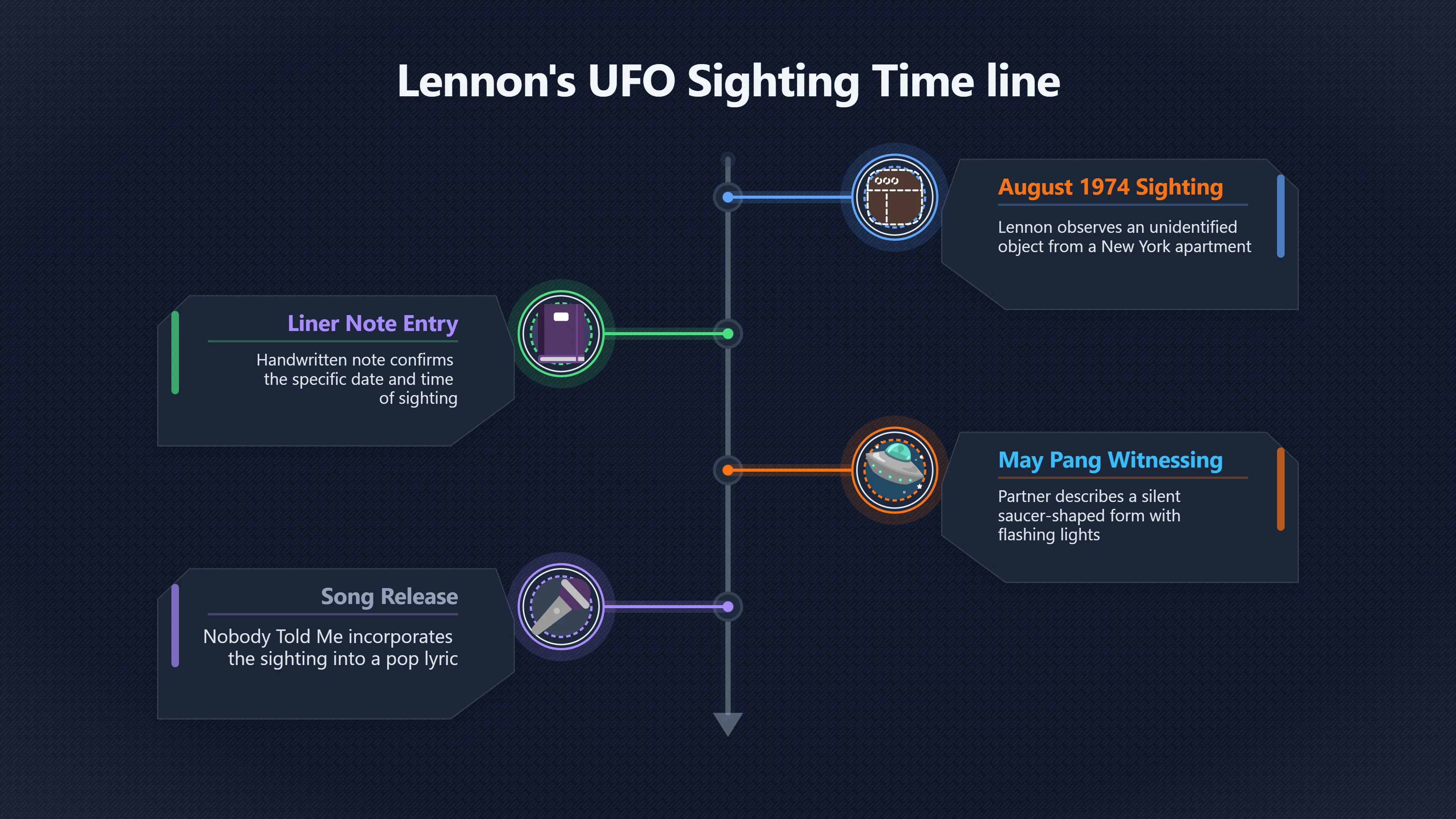
The lyric did not appear in isolation. It followed Lennon’s public claim that on 23 August 1974 he had seen an unidentified flying object from the New York apartment where he was staying during his relationship with May Pang.
Lennon gave the story unusual permanence by including a handwritten note in the liner notes of Walls and Bridges stating:
“On the 23rd Aug. 1974 at 9 o’clock I saw a U.F.O.”
That statement transformed what might otherwise have remained an interview anecdote into part of the album itself. Fans encountering the record repeatedly encountered the claim alongside the music.[Wikipedia]WikipediaWalls and BridgesWalls and Bridges
May Pang later described witnessing the same object, recalling a silent, saucer-shaped form with flashing white lights moving across the sky. According to later accounts, Lennon even contacted photographer Bob Gruen after the experience, although he reportedly laughed off the idea of turning it into a newspaper story. Other reports from the evening suggested additional local witnesses had also reported seeing something unusual, though no evidence established what the object actually was.[Wikipedia]WikipediaMay PangMay Pang
By the time “Nobody Told Me” appeared posthumously in 1984, listeners familiar with the earlier story immediately recognised the lyric as a callback rather than a random reference.
Why songs preserve sightings better than testimony
Lennon’s UFO story illustrates an important difference between celebrity testimony and popular music.
A witness statement normally survives only if people deliberately seek it out through interviews, books or archives. A successful song, by contrast, is replayed, quoted, covered and broadcast for decades. Each new listener encounters the UFO reference without needing prior knowledge of the original incident.
Several factors make the lyric especially durable:
- It is brief and memorable. One line captures the entire association between Lennon and UFOs.
- It avoids explanation. The lyric never tries to convince listeners that extraterrestrials exist, leaving room for interpretation.
- It fits the song’s broader mood. The UFO reference feels like part of a wider commentary on the bizarre character of contemporary life rather than an interruption.
- It encourages retrospective reading. Fans who later discover Lennon’s 1974 account often return to the song and hear the line differently.
This is a good example of how popular music can preserve the cultural memory of an alleged sighting even when the evidential record remains limited.
How pop myth differs from UFO evidence
The continuing popularity of the lyric should not be confused with evidence that Lennon’s sighting has been verified.
The historical record establishes several points with reasonable confidence:
- Lennon publicly stated that he believed he had seen a UFO.
- May Pang independently said she observed the same object.
- Lennon incorporated the experience into the presentation of Walls and Bridges and later echoed it in “Nobody Told Me.”[Wikipedia+2Wikipedia]WikipediaMay PangMay Pang
What the record does not establish is the nature of the object itself. No confirmed physical evidence, authenticated photographs or instrument data have resolved the event. Like many famous UFO reports, the cultural afterlife has become far larger than the available evidence.
That distinction explains why the lyric remains important. Its significance lies less in proving an unexplained aerial phenomenon than in demonstrating how celebrity experience becomes mythology. The song preserves the atmosphere of Lennon’s reported encounter while leaving the factual question unresolved.
A lasting piece of Lennon’s public image
Although “Nobody Told Me” is remembered primarily as a sharp, witty observation on modern life, its UFO line has become inseparable from Lennon’s public image. It links one reported evening in New York with a song that continued reaching audiences after his death, ensuring that the story survived not simply through biographies or UFO literature but through mainstream popular music itself. The result is a rare example of an alleged celebrity sighting being distilled into a single lyric that remains instantly recognisable while stopping well short of claiming certainty about what was actually seen.[Wikipedia]WikipediaNobody Told MeNobody Told Me
Amazon book picks
Further Reading
Books and field guides related to How Lennon Made UFOs Sound Casual. Use these as the next step if you want deeper reading beyond the article.
The UFO Experience: A Scientific Inquiry
Provides context for interpreting celebrity sightings.

UFOs : Generals, Pilots, and Government Officials Go on the R...
Provides context for military reporting of UFO incidents.

Endnotes
1.
Source: Wikipedia
Title: Nobody Told Me
Link:https://en.wikipedia.org/wiki/Nobody_Told_Me
2.
Source: Wikipedia
Title: May Pang
Link:https://en.wikipedia.org/wiki/May_Pang
3.
Source: Wikipedia
Title: Walls and Bridges
Link:https://en.wikipedia.org/wiki/Walls_and_Bridges
4.
Source: songteksten.net
Title: John Lennon
Link:https://songteksten.net/lyric/1707/44743/john-lennon/nobody-told-me.html
5.
Source: sasslantis.ee
Title: John Lennon
Link:https://sasslantis.ee/lyrics-john_lennon-nobody_told_me
Additional References
6.
Source: facebook.com
Title: january 6th 1984 nobody told me john single released the lyrics reference the ye
Link:https://www.facebook.com/cavern.photos/posts/january-6th-1984-nobody-told-me-john-single-released-the-lyrics-reference-the-ye/1041450358020764/
Source snippet
"January 6th 1984 - Nobody Told Me (John single) released...January 6th 1984 - Nobody Told Me (John single) released. [https://www.youtube..."](https://www.youtube...")...
7.
Source: youtube.com
Link:https://www.youtube.com/watch?v=hfU_b5nsvrU
Source snippet
'The Lost Weekend' tells love story between John Lennon, May Pang...
8.
Source: youtube.com
Link:https://www.youtube.com/watch?v=R1bV8gOvJAo
Source snippet
John Lennon interview with Dennis Elsas, 28 Sept 1974 Part 1 of 4...
9.
Source: youtube.com
Link:https://www.youtube.com/watch?v=2axtgni0qmQ
Source snippet
The night John Lennon saw a UFO in NYC...
10.
Source: youtube.com
Title: ‘The Lost Weekend’ tells love story between John Lennon, May Pang
Link:https://www.youtube.com/watch?v=_f5EM4KJCv4
11.
Source: youtube.com
Title: The night John Lennon saw a UFO in NYC
Link:https://www.youtube.com/watch?v=UvfeEKJ_oHM
Source snippet
Nobody Told Me (Remastered 2010)...
12.
Source: whitegum.com
Link:https://whitegum.com/~acsa/songfile/NOBODYTO.HTM
Topic Tree