Within Talk Shows
Why UFO Memories Get Cleaner Over Time
Memory research helps explain why decades-old UFO stories can become more polished without becoming more verifiable.
On this page
- Delay, retelling and post event influence
- How clips freeze one version of the story
- Why sincerity and accuracy are different questions
Page outline Jump by section
Introduction
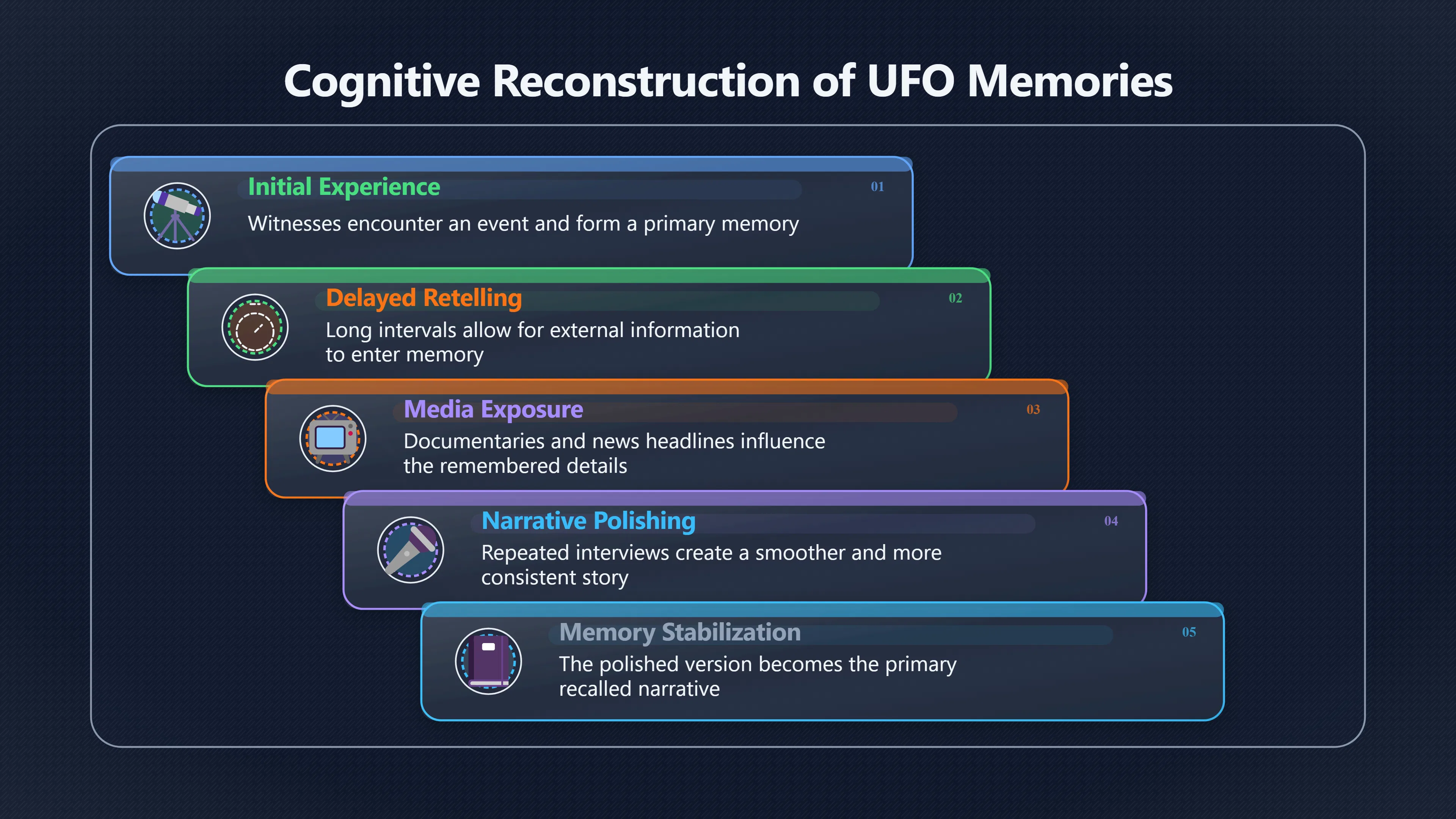
Celebrity UFO stories often reach the public years or even decades after the alleged event, by which time the account may have been told repeatedly in interviews, podcasts, memoirs and late-night television appearances. Cognitive psychology offers an important explanation for why these narratives can become more polished over time without becoming more historically reliable. Memory is not a recording that is replayed unchanged. Each act of remembering involves reconstruction, and every retelling creates opportunities for details to be strengthened, omitted, reorganised or influenced by later information.[PMC]pmc.ncbi.nlm.nih.govPMCA Behavioral Account of the Misinformation Effectby DM Challies · 2011 · Cited by 34 — One cognitive account of the misinformation effect is that memory errors are due to source monit…
 This does not mean that celebrity witnesses are dishonest. A person can sincerely believe a memory while unknowingly reshaping it through repetition. Understanding that distinction is especially important for UFO testimony, where physical evidence is often limited and the witness’s recollection becomes the primary source of information.
Delay, retelling and post-event influence
One of the strongest findings in memory research is that recollection is vulnerable to post-event information. Details encountered after an experience—including conversations, interviews, documentaries, headlines and other people’s interpretations—can become integrated into the remembered event itself. Psychologists describe this as the misinformation effect or, more broadly, a failure of source monitoring, where people become less certain whether a detail came from direct experience or from something learned later.[PMC+2Kent State University Personal Page]pmc.ncbi.nlm.nih.govPMCA Behavioral Account of the Misinformation Effectby DM Challies · 2011 · Cited by 34 — One cognitive account of the misinformation effect is that memory errors are due to source monit…
For celebrity UFO accounts, several factors increase the opportunity for this process:
- Long delays before public discussion. Some stories are first described many years after the alleged encounter.
- Repeated interviews. Every television appearance, podcast or magazine profile requires another reconstruction of the event.
- Audience feedback. Positive reactions encourage memorable moments to be emphasised.
- Exposure to UFO culture. New documentaries, books or public debates may introduce concepts that later become intertwined with an older memory.
Importantly, research does not suggest that every repeated story becomes inaccurate. Rather, it shows that memories remain editable. Later information can reinforce correct details, but it can also introduce distortions that feel just as vivid as genuine recollections.[PMC]pmc.ncbi.nlm.nih.govPMCA Behavioral Account of the Misinformation Effectby DM Challies · 2011 · Cited by 34 — One cognitive account of the misinformation effect is that memory errors are due to source monit…
This helps explain why investigators generally place greater weight on contemporaneous notes, photographs, radar records or independently collected testimony than on recollections first described decades later.
How clips freeze one version of the story
Late-night television creates an additional memory dynamic. Once a celebrity tells a UFO story in a concise, entertaining format, that particular version becomes the one most often replayed online.
A three-minute television segment is easier to remember than an uncertain, hour-long conversation. The celebrity also tends to revisit the same sequence of events in future appearances because it has already proved successful with audiences. Instead of reconstructing the original experience from scratch, they may increasingly reconstruct the previous public telling of it.
Memory researchers describe remembering as a reconstructive process rather than simple playback. Each retrieval can strengthen the currently remembered version, including any changes that have accumulated since the original event. This process is often discussed alongside memory reconsolidation, in which recalled memories become open to updating before being stored again.[Wikipedia]WikipediaEyewitness testimonyEyewitness testimony
As a result, repeated media appearances may produce stories that become:
- more chronologically organised;
- richer in narrative structure;
- lighter on uncertainty;
- more consistent from interview to interview.
Consistency is psychologically persuasive, but it is not independent evidence that the remembered event occurred exactly as described.

Why sincerity and accuracy are different questions
A common misunderstanding in UFO debates is that only two explanations exist: either a witness is lying or every remembered detail is historically accurate.
Memory science rejects this simple choice.
Research on eyewitness testimony consistently shows that honest people can confidently report memories that have shifted over time through normal cognitive processes. Confidence, emotional vividness and narrative fluency are only weak indicators of objective accuracy. Even highly memorable experiences can acquire altered details through repeated recall and exposure to later information. Kent State University Personal Page+2Cambridge University Press & Assessment[personal.kent.edu]personal.kent.eduKent State University Personal PageMisinformation Effects and the Suggestibility of Eyewitness…by MS Zaragoza · Cited by 228 — In this…
This distinction is particularly relevant for celebrities because they often recount unusual experiences in environments designed for storytelling rather than forensic reconstruction. A polished anecdote may therefore reveal more about how the memory has stabilised socially than about the exact sequence of events on the original night.
Recognising this point allows two ideas to coexist:
- the witness may be completely sincere;
- the memory may nevertheless contain reconstructed or reshaped elements.
These are not contradictory positions but established possibilities within cognitive psychology.
Why polished stories are not automatically stronger evidence
Over time, many narratives become easier to follow. Missing transitions are filled in, uncertain timings become approximate certainties and peripheral details disappear. British psychologist Frederic Bartlett demonstrated nearly a century ago that repeated retelling naturally reshapes stories into more coherent forms that better fit existing expectations and knowledge. Later work on eyewitness memory has repeatedly confirmed that remembering is constructive rather than purely reproductive.[Wikipedia]WikipediaEyewitness testimonyEyewitness testimony
For celebrity UFO testimony, this means a later account may sound more convincing than an earlier one simply because it has undergone years of rehearsal. The improvement is often one of presentation rather than verification.
Investigators therefore pay particular attention to questions such as:
- Was the account recorded close to the alleged event?
- Have important details changed across interviews?
- Are new elements traceable to later media coverage?
- Is there independent evidence that does not depend on memory alone?
These questions do not assume deception. Instead, they recognise that memory evolves naturally, especially when unusual experiences become public stories told repeatedly over many years.
What this means when evaluating celebrity UFO accounts
Memory research does not explain away every celebrity UFO claim, nor does it confirm any of them. Instead, it provides a framework for interpreting testimony with appropriate caution.
When an account has been repeated across decades and numerous media appearances, increasing narrative polish should not be mistaken for increasing historical certainty. A compelling storyteller can still be recalling a genuinely puzzling experience, but the remembered version available today may be the product of many cycles of reconstruction, rehearsal and public performance.
Seen in this light, late-night television does more than popularise UFO stories. By encouraging repeated retelling, it can also help stabilise one particular version of a memory—making it culturally memorable while leaving the original experience no easier to verify.
Amazon book picks
Further Reading
Books and field guides related to Why UFO Memories Get Cleaner Over Time. Use these as the next step if you want deeper reading beyond the article.
The Invisible Gorilla
Directly supports discussion of memory changes through repeated retelling.
The Demon-Haunted World
Reinforces evidence-based evaluation of extraordinary testimony.
Eyewitness Testimony
Explains reconstruction and post-event influence on recollection.
eBay marketplace picks
Marketplace Samples
Live-tested eBay searches with available results related to this page.



Endnotes
1.
Source: resolve.cambridge.org
Link:https://resolve.cambridge.org/core/services/aop-cambridge-core/content/view/D91E27C9DBCF5DA8E21FAAC672E3C263/9780511759192c2_p27-55_CBO.pdf/memory-source-monitoring-and-eyewitness-testimony.pdf
Source snippet
Cambridge University Press & AssessmentMemory source monitoring and eyewitness testimonyWhen called upon to testify, eyewitnesses must di...
2.
Source: personal.kent.edu
Link:https://www.personal.kent.edu/~mzaragoz/publications/Zaragoza%20chapter%204%20Garry%20Hayne.pdf
Source snippet
Kent State University Personal PageMisinformation Effects and the Suggestibility of Eyewitness...by MS Zaragoza · Cited by 228 — In this...
3.
Source: Wikipedia
Title: Eyewitness testimony
Link:https://en.wikipedia.org/wiki/Eyewitness_testimony
4.
Source: Wikipedia
Title: Misinformation effect
Link:https://en.wikipedia.org/wiki/Misinformation_effect
Source snippet
Misinformation effectThe misinformation effect occurs when a person's recall of episodic memories becomes less accurate because of pos...
5.
Source: pmc.ncbi.nlm.nih.gov
Title: PMCA Behavioral Account of the Misinformation Effect
Link:https://pmc.ncbi.nlm.nih.gov/articles/PMC3213001/
Source snippet
by DM Challies · 2011 · Cited by 34 — One cognitive account of the misinformation effect is that memory errors are due to source monit...
Additional References
6.
Source: tandfonline.com
Link:https://www.tandfonline.com/doi/full/10.1080/1068316X.2026.2637901
Source snippet
News as a form of post-event information: the effect of...by Z Crittenden · 2026 — Decades of research into the misinformation effect ha...
7.
Source: academicworks.cuny.edu
Link:https://academicworks.cuny.edu/cgi/viewcontent.cgi?article=1018&context=jj_etds
Source snippet
Implicit Post-Event Information Influence Explicit...by HS Chau · 2017 — In the eyewitness setting, the source monitoring model suggests...
8.
Source: researchportal.port.ac.uk
Link:https://researchportal.port.ac.uk/files/2806324/How_to_protect_eyewitness_memory.pdf
Source snippet
Loftus'...Read more...
9.
Source: youtube.com
Title: Your Brain Destroys Your Memories Every Time You Access Them
Link:https://www.youtube.com/watch?v=ycUpNLdUIx4
Source snippet
Why Every Memory You Have is a Reconstruction...
10.
Source: youtube.com
Title: How reliable is your memory? | Elizabeth Loftus
Link:https://www.youtube.com/watch?v=PB2OegI6wvI
Source snippet
Your Brain Destroys Your Memories Every Time You Access Them...
11.
Source: youtube.com
Title: False Memories and the Misinformation Effect
Link:https://www.youtube.com/watch?v=epXmFjTqWeU
Source snippet
How reliable is your memory? | Elizabeth Loftus...
12.
Source: youtube.com
Title: Why Every Memory You Have is a Reconstruction
Link:https://www.youtube.com/watch?v=RwBtp5Oc6KU
Source snippet
The Bizarre Psychology Behind Misinformation...
13.
Source: youtube.com
Title: The Bizarre Psychology Behind Misinformation
Link:https://www.youtube.com/watch?v=1QT15Ab7ctU
Topic Tree