Within Roundups
The Listicle Trap in Celebrity UFO Stories
Celebrity UFO roundups often make belief, anecdotes, media projects and documented cases look more equal than they are.
On this page
- How list formats flatten different claim types
- Why fame can substitute for evidence
- How to read roundups without being misled
Page outline Jump by section
Introduction
Celebrity UFO roundups are designed to entertain, surprise and encourage sharing. In doing so, they often blur an important distinction: a famous person’s belief, a personal anecdote, a television project and a documented incident can all appear side by side as though they carry similar evidential weight. That presentation does not usually involve false information so much as a misleading structure. By placing unlike claims into a single list without clear distinctions, the format can make cultural interest feel like cumulative evidence.
 Understanding this mechanism matters because the public conversation about unidentified anomalous phenomena (UAP) already combines scientific uncertainty, government investigations, popular culture and personal testimony. Official bodies such as NASA distinguish carefully between reports that deserve scientific investigation and claims about extraterrestrial origins, stressing that current evidence does not support the conclusion that UAP represent alien technology.[NASA Science]science.nasa.govNASA ScienceUAPJune 16, 2022 — 9 Jun 2022 — A study team to examine unidentified anomalous phenomena (UAPs) – that is, observations of ev…
How list formats flatten different claim types
The defining feature of a celebrity roundup is that every entry occupies roughly the same amount of space. Whether a celebrity merely says “I think intelligent life probably exists” or claims to have witnessed an unexplained object, each appears as another numbered item in the same sequence.
This creates what communication researchers sometimes call category collapse: fundamentally different kinds of information are presented as though they belong to a single category.
A typical entertainment roundup may include:
- a celebrity expressing a philosophical belief that humanity is unlikely to be alone in the universe;
- someone recounting a personal sighting from years earlier;
- an actor promoting a science-fiction film;
- a musician involved in UFO activism;
- a television presenter making a documentary about unexplained phenomena.
These are all genuine cultural facts, but they are not equivalent forms of evidence. Belief is not observation. Observation is not independent verification. Media participation is not investigation. When these distinctions disappear, readers may unconsciously treat the entire collection as reinforcing a single conclusion rather than representing several unrelated activities.
Why fame can substitute for evidence
Celebrity status changes how people evaluate information. Well-known figures already possess public credibility in one area—acting, music, sport or filmmaking—and audiences can unintentionally transfer that credibility into unrelated subjects.
Psychologists refer to this as a halo effect, where positive impressions in one domain influence judgements in another. In celebrity UFO roundups, this can produce a subtle chain of reasoning:
- many respected celebrities mention UFOs;
- therefore the subject appears increasingly legitimate;
- therefore individual claims may seem stronger than they actually are.
Importantly, this does not mean celebrities are dishonest or incapable of reporting unusual experiences. It means that recognition and familiarity can influence how audiences weigh testimony.
The mechanism is especially powerful because listicles rarely pause to ask questions that investigators would consider essential:
- Was there corroborating evidence?
- Were there multiple independent witnesses?
- Was there radar or sensor data?
- Was the event investigated?
- Were conventional explanations examined?
Instead, recognition often becomes the organising principle. The celebrity’s identity becomes more memorable than the quality of the evidence.
The illusion of cumulative proof
Another consequence of roundup formatting is the creation of apparent quantity.
A list titled “Twenty celebrities who believe in UFOs” can leave readers with the impression that twenty independent pieces of evidence have been assembled. In reality, the list usually combines entirely different kinds of material:
- opinions,
- memories,
- interviews,
- promotional appearances,
- entertainment projects,
- reported sightings.
The number of entries therefore measures celebrity participation in the topic, not the amount of supporting evidence for any particular claim.
This distinction is particularly important because multiple celebrities may simply be repeating familiar stories, drawing inspiration from the same media coverage or expressing broadly similar beliefs without contributing new evidence.

Entertainment rewards memorable stories
Listicles are optimised for attention rather than evidential hierarchy.
Editors generally choose entries that are:
- surprising,
- emotionally engaging,
- visually memorable,
- attached to recognisable names,
- easy to summarise in a sentence or two.
Those incentives naturally favour vivid anecdotes over careful uncertainty.
For example, recent celebrity roundups have placed philosophical statements from film-makers alongside first-hand UFO anecdotes, television productions about extraterrestrials and celebrities who openly speculate about alien life. The result is an engaging survey of popular culture rather than an assessment of evidential strength.[EW.com]ew.comSome stars, including Miley Cyrus and Kacey Musgraves, recounted strange, vivid sightings. Dan Aykroyd, long fascinated by the paranormal…
Because every entry receives similar visual treatment—a photograph, a short quotation and a brief explanation—the presentation itself suggests parity even when the underlying claims differ enormously.
Why official investigations use different standards
Scientific and governmental investigations evaluate reports very differently from entertainment journalism.
NASA’s independent UAP work emphasises collecting higher-quality observational data, improving reporting methods and separating unexplained observations from conclusions about their cause. The agency explicitly states that there is no evidence that currently available UAP data demonstrate extraterrestrial technology.[NASA Science]science.nasa.govNASA ScienceUAPJune 16, 2022 — 9 Jun 2022 — A study team to examine unidentified anomalous phenomena (UAPs) – that is, observations of ev…
That approach differs fundamentally from celebrity roundups.
Investigators ask questions such as:
- How reliable is the observation?
- Can the event be independently verified?
- What instruments recorded it?
- What alternative explanations have been tested?
- How complete is the available dataset?
Entertainment lists usually ask a different question:
Which famous people have interesting things to say about UFOs?
Both questions have legitimate purposes, but they answer different reader needs.
How to read roundups without being misled
Celebrity UFO collections become much more useful once readers separate cultural significance from evidential significance.
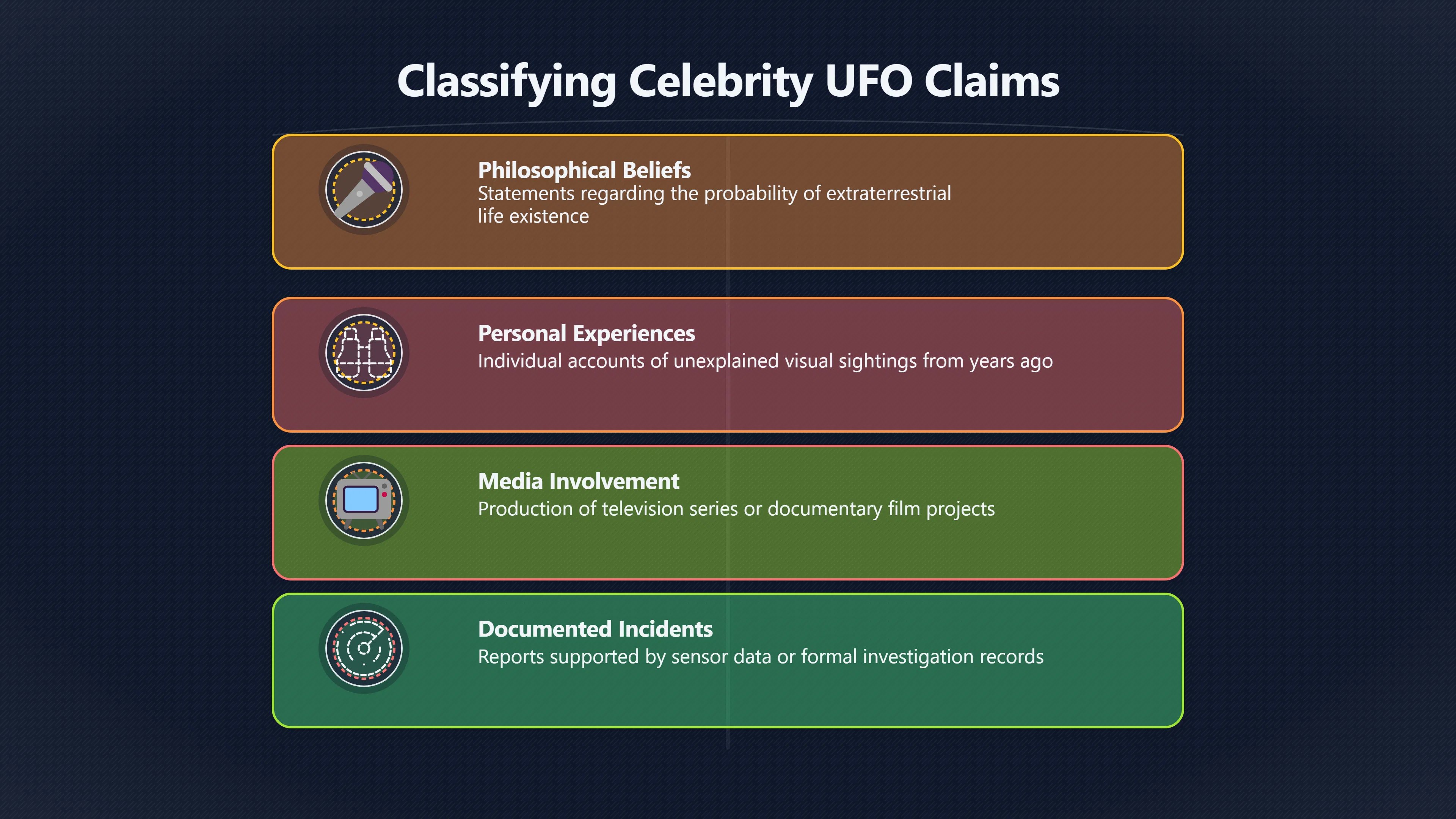
A practical approach is to classify each entry before drawing conclusions.
Belief: “I think aliens probably exist.”
This is an opinion about probability, not evidence of visitation.
Personal experience: “I saw something I could not explain.”
This is testimony about an experience. It may be sincere while remaining difficult to verify.
Media involvement: hosting a documentary, producing a television series or starring in a UFO-related project.
This demonstrates cultural engagement rather than confirmation of the subject matter.
Documented incident: a report supported by multiple sources, sensor data or formal investigation.
This represents a different category of evidence entirely and should be evaluated on its own merits rather than because a celebrity discussed it.
Keeping these categories separate prevents the common mistake of treating popularity, publicity and personal conviction as interchangeable with empirical support.
The real value of celebrity roundups
Celebrity UFO roundups are best understood as maps of popular culture rather than inventories of evidence. They reveal which public figures are fascinated by extraterrestrial life, unexplained aerial phenomena or related stories, and they illustrate how UFOs have become part of mainstream entertainment.
Their weakness is not that they contain celebrities who believe unusual things. It is that the list format naturally compresses very different kinds of claims into a single narrative, making belief, anecdote, advocacy and investigated cases appear more alike than they really are.
Reading them critically means appreciating their cultural insight while resisting the impression that a growing collection of famous names automatically amounts to stronger evidence.
Amazon book picks
Further Reading
Books and field guides related to The Listicle Trap in Celebrity UFO Stories. Use these as the next step if you want deeper reading beyond the article.

UFOs : Generals, Pilots, and Government Officials Go on the R...
Shows differences among evidence types.
eBay marketplace picks
Marketplace Samples
Live-tested eBay searches with available results related to this page.


Endnotes
1.
Source: science.nasa.gov
Link:https://science.nasa.gov/uap/
Source snippet
NASA ScienceUAPJune 16, 2022 — 9 Jun 2022 — A study team to examine unidentified anomalous phenomena (UAPs) – that is, observations of ev...
Published: June 16, 2022
2.
Source: science.nasa.gov
Link:https://science.nasa.gov/wp-content/uploads/2023/09/uap-independent-study-team-final-report.pdf
Source snippet
NASA ScienceIndependent Study Team Report... UFO Reporting Center4. This results in inhomogeneously collected, processed, and curated dat...
3.
Source: ew.com
Link:https://ew.com/celebrities-who-believe-in-aliens-11992570
Source snippet
Some stars, including Miley Cyrus and Kacey Musgraves, recounted strange, vivid sightings. Dan [Aykroyd]({{ 'aykroyd/' | relative_url }}), long fascinated by the paranormal...
Additional References
4.
Source: youtube.com
Link:https://www.youtube.com/watch?v=bR0PaotZxD0
Source snippet
NASA UFO report finds no evidence UAP have extraterrestrial...NASA UFO report finds no evidence UAP have extraterrestrial origins | FULL...
5.
Source: youtube.com
Title: These Celebrities Say They’ve Seen UFOs — And Some of the Stories Are Wild
Link:https://www.youtube.com/watch?v=d9TAr20K7A0
Source snippet
PROOF* THAT ALIENS ARE REAL!!! (*my theory) with Neil deGrasse Tyson...
6.
Source: youtube.com
Title: PROOF* THAT ALIENS ARE REAL!!! (*my theory) with Neil de Grasse Tyson
Link:https://www.youtube.com/watch?v=D_fOTofRoOk
Source snippet
UFO disclosure: The truth about alien life | Hot Take with Jesse Weber...
7.
Source: youtube.com
Title: UFO disclosure: The truth about alien life | Hot Take with Jesse Weber
Link:https://www.youtube.com/watch?v=kiLlRegrMqY
Source snippet
The Age of Disclosure: Who Actually Controls the UAP Secrets?...
8.
Source: worksheets.codalab.org
Title: frequent classes
Link:https://worksheets.codalab.org/rest/bundles/0xd74f36104e7244e8ad99022123e78884/contents/blob/frequent-classes
Source snippet
codalab.org3... ufo 13 bernie 13 embeddedvideo 13 bounty 13 pty 13 013 13 014 13 017 13 019 13 10884 13 radrotator 13 groupon 13 chaptern...
9.
Source: youtube.com
Title: The Age of Disclosure: Who Actually Controls the UAP Secrets?
Link:https://www.youtube.com/watch?v=MWM5AtR3n9o
Topic Tree