Within Celebrity UFOs
Are Celebrity UFO Witnesses More Credible?
Fame can make a UFO witness more visible, but it does not automatically make the claim stronger or weaker.
On this page
- What fame changes
- What investigators still need
- How stories shift over time
Page outline Jump by section
Introduction
Celebrity UFO witnesses are not automatically more credible than ordinary witnesses. Fame can make an account easier to find, harder to ignore and more likely to be repeated by journalists, fans and documentary makers, but it does not by itself improve the underlying evidence. A useful UFO case still depends on the same things whoever reports it: timing, location, independent witnesses, physical or sensor data, prompt reporting, clear separation between what was seen and what was inferred, and whether ordinary explanations have been checked.
That distinction matters because UFO culture often treats a familiar name as a shortcut to trust. A musician, actor, president or astronaut can make an unusual sky report feel more serious, especially when the witness seems sober, sincere and reputationally secure. Yet official and scientific approaches to unidentified anomalous phenomena, or UAP, increasingly stress data quality rather than witness status. NASA’s 2023 independent UAP study argued that current civilian reporting is often sparse and incomplete, and that better systems, calibration, metadata and stigma reduction are needed before unusual reports can be analysed reliably.[NASA Science]science.nasa.govNASA Science…
What fame changes
Fame mainly changes the public life of a UFO story. A sighting by an unknown driver may end as a police note, a local newspaper item or a database entry. A similar account by John Lennon, Jimmy Carter or Kurt Russell can become part of music history, presidential biography or film-culture folklore. The difference is visibility, not proof.
John Lennon’s 1974 UFO story shows this clearly. The sighting is unusually durable because it includes a famous witness, a named date, a second named witness in May Pang, a specific New York location and Lennon’s own album-booklet note saying that he saw a UFO on 23 August 1974. Those details make the account culturally traceable. They do not turn it into a scientifically resolved case, because there is no public chain of instrument data, verified imagery or official traffic reconstruction tied to the object.[The Beatles Bible]beatlesbible.comjohn lennon sees ufo new york cityThe Beatles BibleJohn Lennon: ‘On the 23rd Aug. 1974 at 9 o’clock I saw a UFO’ | 1974 | The Beatles Bible…
Jimmy Carter’s 1969 sighting works in a different way. Carter later filed a report with the International UFO Bureau in 1973 and discussed the event during his 1976 presidential campaign. His public status made the account politically memorable, especially because he reportedly said he would not ridicule people who claimed to have seen unidentified objects. But the core evidential question remains ordinary: what did Carter and the other witnesses see, from where, for how long, under what sky conditions, and what conventional candidates fit the description?[HISTORY]history.comJimmy Carter files report on UFO sightingJimmy Carter files report on UFO sighting | September 18, 1973 | HISTORY…
Kurt Russell’s link to the Phoenix Lights illustrates another fame effect: retrospective amplification. His later statement that he was the pilot who reported lights near Phoenix in 1997 gave a famous face to an already famous mass-sighting event. That matters for public attention, but it does not settle the larger Phoenix Lights debate, which involves multiple times, locations, witness groups and proposed explanations.
Fame can also reduce one barrier that affects ordinary witnesses: fear of being ignored. A celebrity can get coverage without proving the case first. NASA explicitly identified stigma as an obstacle to UAP reporting, arguing that negative perceptions can cause data to be lost before investigators ever see it.[NASA Science]science.nasa.govNASA Science… For an ordinary witness, ridicule may prevent a report. For a celebrity, the same ridicule may become publicity.
What investigators still need
Investigators do not need a famous witness first. They need usable information. France’s official GEIPAN programme, run through the French space agency CNES, states that anyone can provide testimony, but it focuses on direct witnesses and asks them to complete a technical questionnaire. It also treats photos, videos, sketches and detection data as supporting material, not as automatic proof.[cnes-geipan.fr]cnes-geipan.frMission & Geipan | GEIPANMission & Geipan | GEIPAN
That approach is important because UFO cases often begin with perception under difficult conditions: night skies, distance, glare, brief duration, uncertain scale and few reference points. A witness may be honest and still misjudge altitude, speed, size or motion. This is not a special failing of celebrities or ordinary people. It is a normal limitation of human observation.
A practical credibility assessment asks questions such as:
- Was the account recorded quickly? Reports made soon after an event are generally easier to test than memories reconstructed years later.
- Were there independent witnesses? Several people repeating one another after discussion is weaker than separate reports collected before witnesses influence each other.
- Is there instrument or environmental data? Radar, flight logs, satellite information, astronomical data, weather records and calibrated imagery can help distinguish a mystery from a misidentified object.
- Is the claim modest or inflated? “I saw lights I could not identify” is very different from “I saw an alien spacecraft.”
- Has the story changed? Later interviews, documentaries and fan retellings can add detail, confidence or meaning that was not present in the first account.
GEIPAN’s classification system reflects this caution. It distinguishes between cases that are identified after investigation, probably identified, not identified because of lack of data, and not identified after investigation. That separation matters: a case can remain unidentified because the evidence is poor, not because the object was extraordinary.[cnes-geipan.fr]cnes-geipan.frMethodology | GEIPANMethodology | GEIPAN
Why ordinary witnesses can be just as important
Ordinary witnesses often provide the bulk of UFO material. Most historical and official collections were not built from celebrities; they were built from pilots, police officers, military personnel, astronomers, farmers, motorists, children, technicians and residents who happened to be looking at the sky. In that sense, ordinary witnesses are not background noise. They are the main population from which UFO cases emerge.
Project Blue Book and earlier US Air Force investigations depended heavily on ordinary and professional witnesses, not celebrity witnesses. AARO’s 2024 historical review notes that the Battelle Memorial Institute supported the Air Force by studying witness recall, improving observer questionnaires and developing a statistical system for UFO reports. The same review says those historical projects found no evidence of extraterrestrial origin, while also showing how seriously witness collection and report quality were treated as investigative problems.[U.S. Department of War]media.defense.govU.S. Department of War AARO Historical Record Report Volume 1U.S. Department of War AARO Historical Record Report Volume 1(https://media.defense.gov/2024/Mar/08/2003409233/-1/-1/0/DOPSR-2024-0263-AARO-HISTORICAL-RECORD-REPORT-VOLUME-1-2024.PDF)
Ordinary witnesses may even have advantages in some cases. They are less likely to attract entertainment framing, less likely to have their account folded into a public persona, and less likely to become the centre of a fandom-driven story. A police officer’s report, an air-traffic-control record or a farmer’s immediate call to authorities may be less glamorous than a celebrity anecdote, but it can be more useful if it is prompt, specific and independently corroborated.
The reverse is also true: an ordinary report with no time, no direction, no duration, no second witness and no supporting data remains weak. The key comparison is not celebrity versus non-celebrity. It is well-documented versus poorly documented.

How stories shift over time
Celebrity UFO stories are especially vulnerable to narrative drift because they are retold in interviews, biographies, tribute articles and fan media. A careful first statement may become bolder as later versions add atmosphere, emotion or interpretation. Over time, “unidentified” can slide into “alien”, “strange lights” can become “craft”, and “I could not explain it” can become “there is no earthly explanation.”
This is one reason John Lennon’s case remains useful as a cautionary example. The strongest version of the story is not the most dramatic retelling; it is the modest evidential core: Lennon and Pang said they saw something unusual over New York, Lennon dated it in his album material, and the account became part of his public record. The weaker versions are those that treat the sighting as evidence of extraterrestrial visitation without adding new evidence.
Jimmy Carter’s account shows another kind of restraint. He reported seeing an unidentified object, but later comments attributed to him distinguished that experience from belief that alien spacecraft had visited Earth. That distinction is crucial. A witness can sincerely report a UFO while rejecting the leap to extraterrestrial explanation.
J. Allen Hynek, the astronomer long associated with Project Blue Book and later with the Center for UFO Studies, also warned against overvaluing evidence simply because it looks impressive. In his discussion of UFO photographs, he argued that a photograph is still a kind of report and depends on the credibility and context of the people offering it; he also noted that many images in Blue Book files turned out to be hoaxes, misidentifications or ordinary objects.[Center for UFO Studies]cufos.orgCenter for UFO Studies The same caution applies to famous testimony: a compelling witness is not a substitute for a complete case.
The credibility trap
The main risk with celebrity UFO witnesses is not that they are lying. Most useful scepticism does not begin by accusing witnesses of fraud. The risk is that audiences confuse social credibility with evidential strength.
A respected actor may be sincere. A president may be careful. A musician may have no obvious reason to invent a sighting. None of that proves what the object was. In UFO cases, sincerity and accuracy are different questions. A person can be truthful about their experience and wrong about distance, size, movement or cause.
This trap also affects “high-status” non-celebrity witnesses, such as pilots, military officers and scientists. Their training may make some observations more useful, especially if they know aircraft, weather, instruments or flight procedures. But even trained observers can misperceive unfamiliar objects in poor conditions. NASA’s UAP report emphasised that future progress depends on multiple well-calibrated sensors, metadata and systematic data acquisition, not simply on collecting more dramatic stories.[NASA Science]science.nasa.govNASA Science…
The opposite mistake is to dismiss ordinary witnesses because they lack status. That can lose valuable data. NASA’s concern about stigma points in the other direction: the reporting environment should make it easier for people to submit observations without embarrassment, while still applying rigorous analysis afterwards.[NASA Science]science.nasa.govNASA Science…
A better way to read celebrity UFO accounts
The fairest approach is to treat celebrity UFO witnesses as visible witnesses, not superior witnesses. Their accounts may be historically interesting, culturally influential and sometimes genuinely useful. But they should pass through the same evidential filter as everyone else’s.
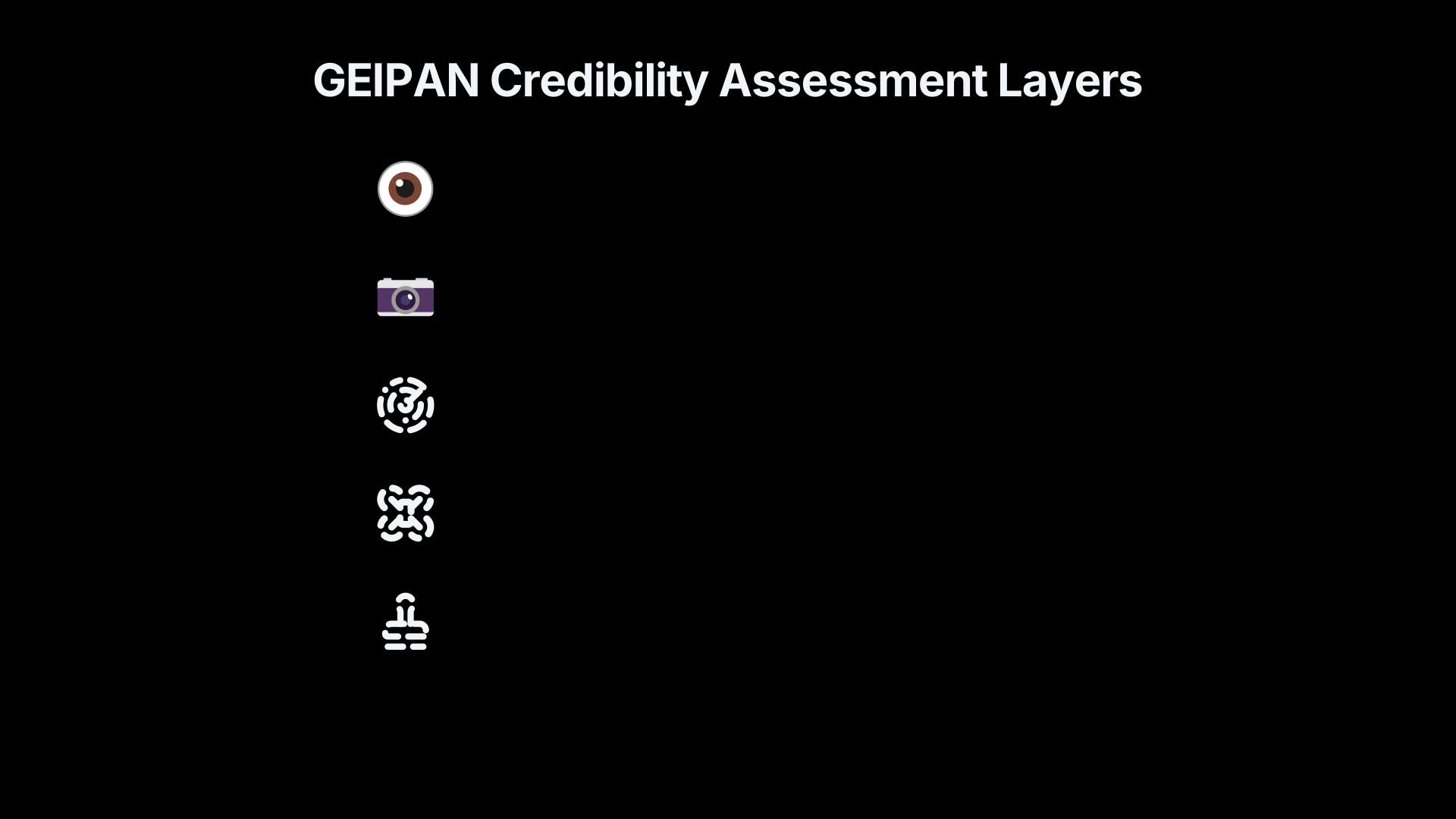
A balanced reading separates three layers:
The experience: What did the person say they saw? This should be described in the witness’s own terms as far as possible, without upgrading “light” into “craft” or “unidentified” into “alien”.
The documentation: When was the account recorded, by whom, and with what supporting material? A dated report, second witness and known location are stronger than a decades-later anecdote.
The interpretation: What explanations have been considered? This is where astronomy, aviation, military activity, weather, balloons, drones, satellites, optical effects and hoaxes enter the assessment.
Celebrity accounts are most valuable when they bring attention to the need for better reporting without demanding belief on reputation alone. Ordinary accounts are most valuable when they are detailed enough to investigate and are not lost to stigma or poor collection systems. In both cases, the standard should be neither ridicule nor reverence. It should be disciplined curiosity.
Amazon book picks
Further Reading
Books and field guides related to Are Celebrity UFO Witnesses More Credible?. Use these as the next step if you want deeper reading beyond the article.

UFOs : Generals, Pilots, and Government Officials Go on the R...
Highlights testimony supported by experienced observers.
eBay marketplace picks
Marketplace Samples
Live-tested eBay searches with available results related to this page.
Endnotes
1.
Source: science.nasa.gov
Link:https://science.nasa.gov/wp-content/uploads/2023/09/uap-independent-study-team-final-report.pdf
Source snippet
NASA Science...
2.
Source: history.com
Title: Jimmy Carter files report on UFO sighting
Link:https://www.history.com/this-day-in-history/september-18/carter-files-report-on-ufo-sighting
Source snippet
Jimmy Carter files report on UFO sighting | September 18, 1973 | HISTORY...
Published: September 18, 1973
3.
Source: cnes-geipan.fr
Title: Mission & Geipan | GEIPAN
Link:https://www.cnes-geipan.fr/en/missions-methodes-et-resultats
4.
Source: cnes-geipan.fr
Title: Methodology | GEIPAN
Link:https://www.cnes-geipan.fr/en/node/58788
5.
Source: cufos.org
Title: Center for UFO Studies
Link:https://cufos.org/PDFs/books/The_Hynek_UFO_Report.pdf
6.
Source: science.nasa.gov
Link:https://science.nasa.gov/uap/
7.
Source: war.gov
Title: dod report discounts sightings of extraterrestrial technology
Link:https://www.war.gov/News/News-Stories/Article/Article/3701297/dod-report-discounts-sightings-of-extraterrestrial-technology/
8.
Source: war.gov
Title: dod examining unidentified anomalous phenomena
Link:https://www.war.gov/News/News-Stories/Article/Article/3965403/dod-examining-unidentified-anomalous-phenomena/
9.
Source: war.gov
Link:https://www.war.gov/medialink/ufo/061226/release_03/documents/CIA-UAP-015-Project_Blue_Book_Special_Report_No_14.pdf
10.
Source: cnes-geipan.fr
Link:https://www.cnes-geipan.fr/en/node/58791
11.
Source: cnes-geipan.fr
Link:https://www.cnes-geipan.fr/sites/default/files/Aids_to_identification_of_flying_objects_0.pdf
12.
Source: history.com
Title: of UFOs
Link:https://www.history.com/articles/history-of-ufos
13.
Source: cnes.fr
Link:https://cnes.fr/en/projects/geipan
14.
Source: aaro.mil
Link:https://www.aaro.mil/UAP-Cases/Official-UAP-Imagery/
15.
Source: aaro.mil
Link:https://www.aaro.mil/
16.
Source: aaro.mil
Title: UAP Records
Link:https://www.aaro.mil/UAP-Records/
17.
Source: biography.com
Title: J. Allen Hynek
Link:https://www.biography.com/scientists/j-allen-hynek
18.
Source: beatlesbible.com
Title: john lennon sees ufo new york city
Link:https://www.beatlesbible.com/1974/08/23/john-lennon-sees-ufo-new-york-city/
Source snippet
The Beatles BibleJohn Lennon: ‘On the 23rd Aug. 1974 at 9 o’clock I saw a UFO’ | 1974 | The Beatles Bible...
19.
Source: media.defense.gov
Title: U.S. Department of War AARO Historical Record Report Volume 1
Link:https://media.defense.gov/2024/Mar/08/2003409233/-1/-1/0/DOPSR-2024-0263-AARO-HISTORICAL-RECORD-REPORT-VOLUME-1-2024.PDF
20.
Source: cufos.org
Link:https://cufos.org/
21.
Source: cufos.org
Link:https://cufos.org/about-us/
22.
Source: Wikipedia
Title: J. Allen Hynek
Link:https://en.wikipedia.org/wiki/J._Allen_Hynek
23.
Source: Wikipedia
Title: Project Blue Book
Link:https://en.wikipedia.org/wiki/Project_Blue_Book
24.
Source: Wikipedia
Title: Phoenix Lights
Link:https://en.wikipedia.org/wiki/Phoenix_Lights
25.
Source: Wikipedia
Title: Center for UFO Studies
Link:https://en.wikipedia.org/wiki/Center_for_UFO_Studies
Additional References
26.
Source: youtube.com
Title: These Celebrities Say They’ve Seen UFOs — And Some of the Stories Are Wild
Link:https://www.youtube.com/watch?v=d9TAr20K7A0
Source snippet
10 Stars Who Believe They Had Alien Encounters...
27.
Source: archives.gov
Link:https://www.archives.gov/research/topics/uaps/presidential-libraries
28.
Source: youtube.com
Title: The night John Lennon saw a UFO in NYC
Link:https://www.youtube.com/watch?v=UvfeEKJ_oHM
Source snippet
Kurt Russell Shares His Close Encounter With A UFO | The Jonathan Ross Show...
29.
Source: researchgate.net
Link:https://www.researchgate.net/publication/384905393_The_Reliability_of_UFO_Witness_Testimony
30.
Source: researchgate.net
Link:https://www.researchgate.net/publication/377002347_Southwest_Flight_2452_UAP_Case_Study_Unraveling_the_Mystery_in_American_Airspace
31.
Source: researchgate.net
Link:https://www.researchgate.net/publication/380530617_UAP_Research_in_Germany_Single_Case_Studies_Data_Management_Understanding_of_Strangeness
32.
Source: researchgate.net
Link:https://www.researchgate.net/publication/400348279_Science_in_a_Stigmatized_Field_Challenges_and_Opportunities_in_the_Emerging_Research_Domain_of_UAP
33.
Source: facebook.com
Link:https://www.facebook.com/SETIInstitute/posts/a-skeptical-guide-to-ufo-cases-and-claimswith-steven-spielbergs-new-blockbuster-/1395521999289439/
34.
Source: facebook.com
Link:https://www.facebook.com/FOX10Phoenix/posts/a-newly-resurfaced-aviation-audio-clip-shared-online-has-drawn-attention-after-a/1196593622674762/
35.
Source: aiaa.org
Link:https://aiaa.org/wp-content/uploads/2025/08/AIAA-UAPIOC-Opinion-Paper-UAP-Occupational-Safety-Reporting_ForPublication_kb.pdf
Topic Tree