Within De Longe
How To The Stars changed UFO coverage
To The Stars helped turn UAP from celebrity curiosity into a format journalists, TV producers and officials could discuss seriously.
On this page
- Why De Longe built an institution instead of only giving interviews
- How celebrity, officials and entertainment were packaged together
- What changed in the media grammar of UAP stories
Page outline Jump by section
Introduction
Tom DeLonge’s greatest influence on modern UAP (Unidentified Aerial Phenomena) coverage was not simply attracting attention as a celebrity. It was creating an organisation that gave journalists, television producers and policymakers a new way to frame the subject. When DeLonge launched To The Stars Academy of Arts & Science (TTSA) in 2017, he deliberately combined entertainment, former defence officials, aerospace figures and public storytelling under one institutional brand. That structure allowed UAP stories to be presented as questions of aviation safety, intelligence and government transparency rather than as conventional UFO folklore.
 The significance of TTSA lies less in proving extraordinary claims than in changing the media environment. Reporters suddenly had identifiable spokespeople with military and intelligence credentials, documentary-ready visual material and an organisation capable of sustaining news cycles. Whether one accepts or rejects TTSA’s interpretations, the company helped move UAP reporting into mainstream political and national security journalism.
Why DeLonge built an institution instead of only giving interviews
Many celebrities interested in UFOs have relied on personal testimony or media appearances. DeLonge instead attempted to create an organisation that looked like a hybrid of a media studio, research venture and aerospace company.
TTSA launched with divisions dedicated to entertainment, science and aerospace, signalling that UAPs would be discussed across multiple formats rather than through occasional interviews. Company filings and public presentations positioned the organisation as something intended to generate films, books, television programming and research simultaneously, making the institution—not only DeLonge—the continuing public face of the subject.[Wikipedia]WikipediaTo The Stars IncTo The Stars Inc
This institutional approach mattered because journalists generally treat organisations differently from individual enthusiasts. Instead of asking whether a rock musician believed in UFOs, reporters could cover:
- a company announcing research initiatives;
- former government officials joining an advisory board;
- documentary productions tied to identifiable evidence;
- public events resembling press conferences rather than fan conventions.
The shift was largely about presentation. TTSA supplied an organisational framework through which media outlets could discuss UAP without immediately placing the story in entertainment or paranormal sections.
How celebrity, officials and entertainment were packaged together
TTSA’s launch illustrated a carefully constructed blend of credibility signals drawn from different audiences.
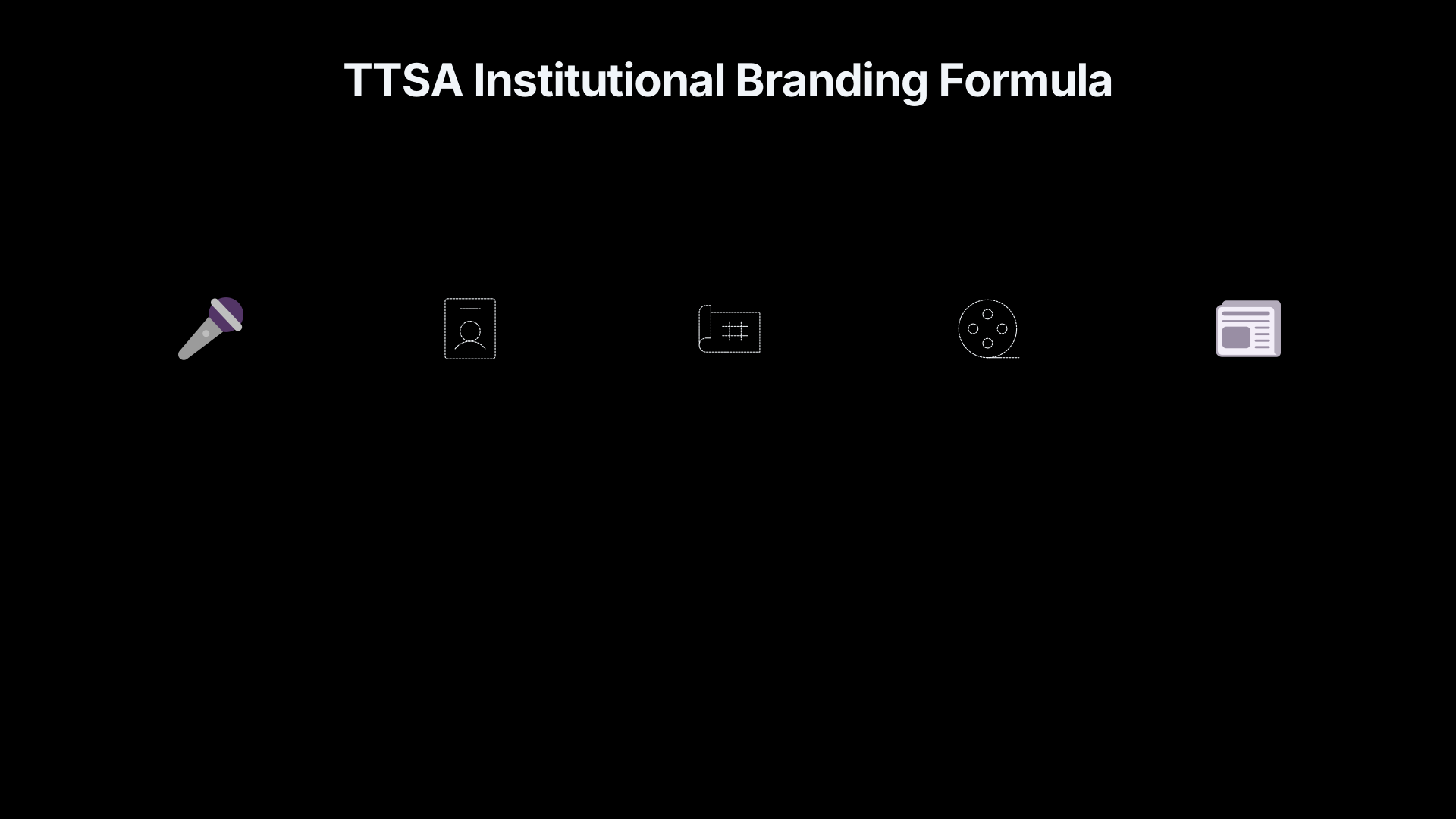
DeLonge contributed public recognition and media reach. Alongside him appeared former Pentagon and intelligence figures including Luis Elizondo, Christopher Mellon and aerospace engineer Steve Justice. Their biographies gave reporters recognised institutional affiliations that could be cited independently of DeLonge’s celebrity status.[Wikipedia+2Wikipedia]WikipediaTo The Stars IncTo The Stars Inc
This combination solved a long-standing problem in UFO journalism. Historically, stories often depended on anonymous witnesses, amateur investigators or enthusiasts. TTSA instead offered:
- a celebrity capable of attracting audiences;
- former officials familiar with defence institutions;
- aviation and engineering expertise;
- commercial media production capable of sustaining public interest.
The entertainment component was equally important. Rather than separating documentaries, books and fictional storytelling from advocacy, TTSA treated them as complementary. Fictional projects such as Sekret Machines created audience interest, while non-fiction interviews, television appearances and public presentations encouraged viewers to interpret UAP through military and intelligence narratives rather than purely science-fiction imagery.[Wikipedia]WikipediaTo The Stars IncTo The Stars Inc
This was an unusual communications strategy: entertainment generated attention, while institutional voices attempted to legitimise the discussion.

What changed in the media grammar of UAP stories
Perhaps TTSA’s most lasting contribution was changing how journalists wrote about unexplained aerial phenomena.
Before 2017, mainstream reporting frequently framed UFO stories around eyewitness accounts, unexplained lights or speculation about extraterrestrials. Following TTSA’s emergence and the publication of military videos, reporting increasingly adopted vocabulary associated with national security:
- “unidentified aerial phenomena” instead of “UFOs”;[wired.com]wired.comwhat is up with those pentagon ufo videosThe article included videos of UAPs and featured accounts from Navy pilots. The program, Advanced Aviation Threat Identification Program…
- Navy pilots rather than civilian witnesses;
- classified programmes rather than conspiracy theories;
- aviation safety rather than alien visitation;
- intelligence oversight rather than paranormal belief.
This change did not require journalists to endorse extraordinary explanations. Instead, it allowed editors to justify coverage because the subject involved military operations, defence reporting and government accountability.[Wikipedia]WikipediaAdvanced Aerospace Threat Identification ProgramAdvanced Aerospace Threat Identification Program
The distinction proved important. Stories could now be published in defence, politics or investigative sections instead of lifestyle or entertainment pages.
The importance of the 2017 media rollout
TTSA’s influence cannot be separated from the coordinated publication of the December 2017 reports in The New York Times, The Washington Post and Politico concerning the Pentagon’s Advanced Aerospace Threat Identification Program (AATIP) and military encounter videos.
Christopher Mellon and Luis Elizondo, both associated with TTSA, played significant roles in bringing the Navy videos into public discussion. The simultaneous appearance of respected newspapers, named former officials and authenticated military footage produced a powerful journalistic package. The story became news not because it demonstrated extraterrestrial technology, but because reputable institutions were reporting on documented military encounters and an obscure government programme.[Wikipedia+2Wikipedia]WikipediaChristopher MellonChristopher Mellon
The timing reinforced TTSA’s strategy. On the same day that major newspapers published their investigations, TTSA provided related material and commentary through its own media channels, allowing audiences to move seamlessly from traditional journalism to the organisation’s broader narrative.[Rolling Stone]rollingstone.comtom delonges to the stars academy posts declassified ufo videos 126497military videos purportedly showing evidence of unidentified flying…
Why television producers found the format attractive
Television benefits from recurring characters, visual evidence and institutional conflict. TTSA offered all three.
Military cockpit videos supplied compelling visuals. Former officials provided interview subjects comfortable discussing intelligence processes. DeLonge himself served as the recognisable public figure capable of introducing general audiences to a complex topic.
This package made UAP programming easier to commission than traditional UFO documentaries centred on anonymous testimony. Producers could frame episodes around questions such as:
- Why were Navy pilots reporting these incidents?
- What did former defence officials think had happened?
- Should governments investigate unidentified objects more systematically?
These are journalistic questions rather than claims about extraterrestrial life, making them more compatible with mainstream factual television.
Credibility did not eliminate criticism
The increased legitimacy of UAP reporting should not be confused with acceptance of TTSA’s interpretations.
Journalists, scientists and sceptical investigators have argued that some media coverage relied too heavily on limited evidence or insufficiently tested assumptions. Critics have questioned aspects of the reporting surrounding AATIP, the interpretation of military videos and some of TTSA’s broader scientific ambitions, including its public discussion of purported “metamaterials”. Others have argued that mainstream coverage sometimes adopted an unnecessarily mysterious framing before conventional explanations had been fully examined.[Wikipedia+2WIRED]WikipediaPentagon UFO videosPentagon UFO videos
Government reviews have likewise drawn a distinction between acknowledging genuinely unidentified observations and concluding that they represent non-human technology. Subsequent Pentagon and NASA assessments have consistently stated that, while some incidents remain unexplained, there is no publicly available evidence establishing an extraterrestrial origin.
This distinction is central to understanding TTSA’s media impact. The organisation succeeded in making UAP a serious journalistic subject, but it did not settle the underlying scientific debate.
The lasting change
TTSA’s enduring contribution was communicative rather than evidential. It demonstrated that a celebrity-led organisation could combine recognised public figures, former officials, documentary production and military source material into a package that mainstream news organisations considered reportable.
As a result, discussions of UAP increasingly migrated from fringe entertainment into conversations about defence policy, intelligence oversight, aviation safety and government transparency. That transformation reshaped the cultural status of the topic even as fundamental questions about the phenomena themselves remain unresolved.
Amazon book picks
Further Reading
Books and field guides related to How To The Stars changed UFO coverage. Use these as the next step if you want deeper reading beyond the article.

UFOs : Generals, Pilots, and Government Officials Go on the R...
Provides broader context for official involvement.
eBay marketplace picks
Marketplace Samples
Live-tested eBay searches with available results related to this page.

Endnotes
1.
Source: Wikipedia
Title: To The Stars Inc
2.
Source: Wikipedia
Title: Christopher Mellon
Link:https://en.wikipedia.org/wiki/Christopher_Mellon
3.
Source: Wikipedia
Title: Advanced Aerospace Threat Identification Program
Link:https://en.wikipedia.org/wiki/Advanced_Aerospace_Threat_Identification_Program
4.
Source: Wikipedia
Title: [Pentagon UFO videos]({{ ‘navy-videos/’ | relative_url }})
Link:https://en.wikipedia.org/wiki/Pentagon_UFO_videos
5.
Source: wired.com
Title: what is up with those pentagon ufo videos
Link:https://www.wired.com/story/what-is-up-with-those-pentagon-ufo-videos
Source snippet
The article included videos of UAPs and featured accounts from Navy pilots. The program, Advanced Aviation Threat Identification Program...
6.
Source: rollingstone.com
Title: tom delonges to the stars academy posts declassified ufo videos 126497
Link:https://www.rollingstone.com/culture/culture-news/tom-delonges-to-the-stars-academy-posts-declassified-ufo-videos-126497/
Source snippet
military videos purportedly showing evidence of unidentified flying...
Additional References
7.
Source: tothestars.media
Link:https://tothestars.media/blogs/press-and-news/to-the-stars-academy-of-arts-science-acknowledges-the-pentagons-official-release-of-uap-video-footage?srsltid=AfmBOop7323UUaCOnP28o2Po8-clcmoZNhBi1Vjzf2XtYdTRvQ_wcNU5
Source snippet
To the Stars Academy of Arts & Science Acknowledges...28 Apr 2020 — The Pentagon officially released three videos of Unidentified Aerial...
8.
Source: theguardian.com
Title: pentagon released ufo videos chase aliens
Link:https://www.theguardian.com/science/2026/apr/22/pentagon-released-ufo-videos-chase-aliens
Source snippet
The Pentagon released its UFO videos – so I went to...22 Apr 2026 — He claimed he ran a secret Pentagon programme called the Advanced Ae...
9.
Source: facebook.com
Link:https://www.facebook.com/FOX56wolftv/posts/the-defense-department-on-friday-released-new-ufo-files-of-sightings-in-the-nort/1716092949982123/
Source snippet
rtheastern U.S., which FBI agents also observed after deeming...
10.
Source: youtube.com
Title: U.S. Navy Discloses Existence of “Unidentified Aerial Phenomena”
Link:https://www.youtube.com/watch?v=c-U8o8swmdI
Source snippet
Tom Delonge: Skinwalkers & CIA Spooks | With Jim Semivan...
11.
Source: youtube.com
Title: Unidentified: Inside America’s UFO Investigation Promo
Link:https://www.youtube.com/watch?v=ewnJ6okvsK0
Source snippet
Go Fast: Official USG Footage of UAP for Public Release...
12.
Source: youtube.com
Title: How blink-182’s Singer Proved That [Aliens Exist]({{ ‘aliens-exist/’ | relative_url }})
Link:https://www.youtube.com/watch?v=CDZ40bmirVo
Source snippet
U.S. Navy Discloses Existence of "Unidentified Aerial Phenomena"...
13.
Source: youtube.com
Title: Tom Delonge: Skinwalkers & CIA Spooks | With Jim Semivan
Link:https://www.youtube.com/watch?v=OBSdg3nwxoo
Source snippet
Meanwhile... Navy Confirms Existence Of UFOs...
14.
Source: youtube.com
Link:https://www.youtube.com/watch?v=IK1nXr-ia2Y
Source snippet
Unidentified: Inside America's UFO Investigation Promo...
15.
Source: youtube.com
Link:https://www.youtube.com/watch?v=rO_M0hLlJ-Q
Source snippet
the Pentagon's three declassified UFO videos taken by...The videos were taken during training flights and the 2017 leaks were published...
16.
Source: youtube.com
Title: Go Fast: Official USG Footage of UAP for Public Release
Link:https://www.youtube.com/watch?v=wxVRg7LLaQA
Topic Tree