Within Hard Data
What Radar Can and Cannot Prove
Radar can raise the evidential standard, but false returns, clutter and missing context can still leave a case unresolved.
On this page
- Why radar changes a sighting claim
- False returns and tracking artefacts
- The missing records in celebrity accounts
Page outline Jump by section
Introduction
Radar is often presented as the decisive piece of evidence in UFO stories because, unlike a human witness, it is an instrument that measures physical returns. In reality, radar can substantially strengthen a sighting, but it rarely settles the question on its own. Investigators need to know what type of radar produced the return, how it was operating, whether multiple sensors agreed, and whether weather, terrain, interference or system limitations could have created a misleading track. Modern studies of unidentified aerial phenomena (UAP) consistently argue that the value of radar lies in combining it with other evidence rather than treating it as proof by itself.[NASA Science]science.nasa.govNASA ScienceUAP9 Jun 2022 — A study team to examine unidentified anomalous phenomena (UAPs) – that is, observations of events in the sky…
 This distinction is especially important when assessing celebrity UFO accounts. A famous witness may describe an extraordinary event, but unless the report can be linked to preserved radar data, air traffic records and other independently verifiable information, the story remains primarily testimonial rather than instrumentally confirmed.
Why radar changes a sighting claim
Radar differs from photographs because it records measurements rather than appearances. Depending on the system, it may estimate an object’s range, direction, altitude and speed by transmitting radio waves and analysing the reflected signal. Air traffic control radars, military surveillance radars and weather radars are designed for different purposes, so their data cannot automatically be compared without understanding their capabilities and limitations.
When a visual sighting coincides with radar detection, investigators gain an independent source of information. If several radars detect the same target, or if radar data matches infrared imagery, aircraft systems and eyewitness reports, confidence generally increases that a real object of some kind was present. This does not identify the object, but it reduces the likelihood that the entire event resulted from a single observer’s misperception. Recent US government assessments similarly note that many reported UAP events involved multiple sensors, while emphasising that unidentified does not imply extraordinary origin.[U.S. Department of War]media.defense.govDOPSR 2024 0263 AARO HISTORICAL RECORD REPORT VOLUMEDepartment of WarAARO Historical Record Report Volume 18 Mar 2024 — established Project BLUE BOOK to study UFO phenomena. Based at Wright…
NASA’s independent UAP study reached a similar conclusion. Rather than treating radar as conclusive, it argued that progress depends on calibrated sensors, preserved metadata and multiple independent measurements collected under known conditions.[NASA Science]science.nasa.govNASA ScienceUAP9 Jun 2022 — A study team to examine unidentified anomalous phenomena (UAPs) – that is, observations of events in the sky…
Why radar alone still leaves uncertainty
The popular image of radar is a perfect electronic eye. Operational radar is far more complicated.
Several factors can produce ambiguous or misleading returns:
- Ground clutter: Buildings, mountains and terrain can generate unwanted echoes.
- Weather effects: Rain, temperature inversions and atmospheric conditions may create anomalous propagation that bends radio waves and produces false targets.
- Multipath reflections: Signals can bounce from several surfaces before returning, making one object appear in multiple positions.
- Tracking software: Modern radar systems combine repeated detections into tracks. Errors in this processing can briefly create or lose targets.
- Coverage limitations: Radar beams do not observe every altitude equally, and some systems deliberately filter slow-moving or stationary objects.
Because of these effects, a radar return is not automatically evidence of an unknown craft. Aviation investigators routinely examine raw returns, system settings, maintenance records and surrounding traffic before deciding whether a target represents a genuine aircraft or an artefact of the sensing system. Similar issues are well documented in radar engineering, where so-called “ghost” targets and multipath reflections are recognised technical challenges rather than unusual anomalies.[arXiv]arxiv.orgThe Radar Ghost Dataset – An Evaluation of Ghost Objects in Automotive Radar DataApril 1, 2024…
False returns and tracking artefacts
Many UFO discussions refer simply to “radar confirmation”, but this phrase compresses several distinct possibilities.
A primary radar detects reflected energy from an object itself. A secondary surveillance radar, widely used in civil aviation, instead relies on an aircraft’s transponder responding to an interrogation signal. Losing one type of contact while retaining another can have entirely conventional explanations.
Investigators also distinguish between:
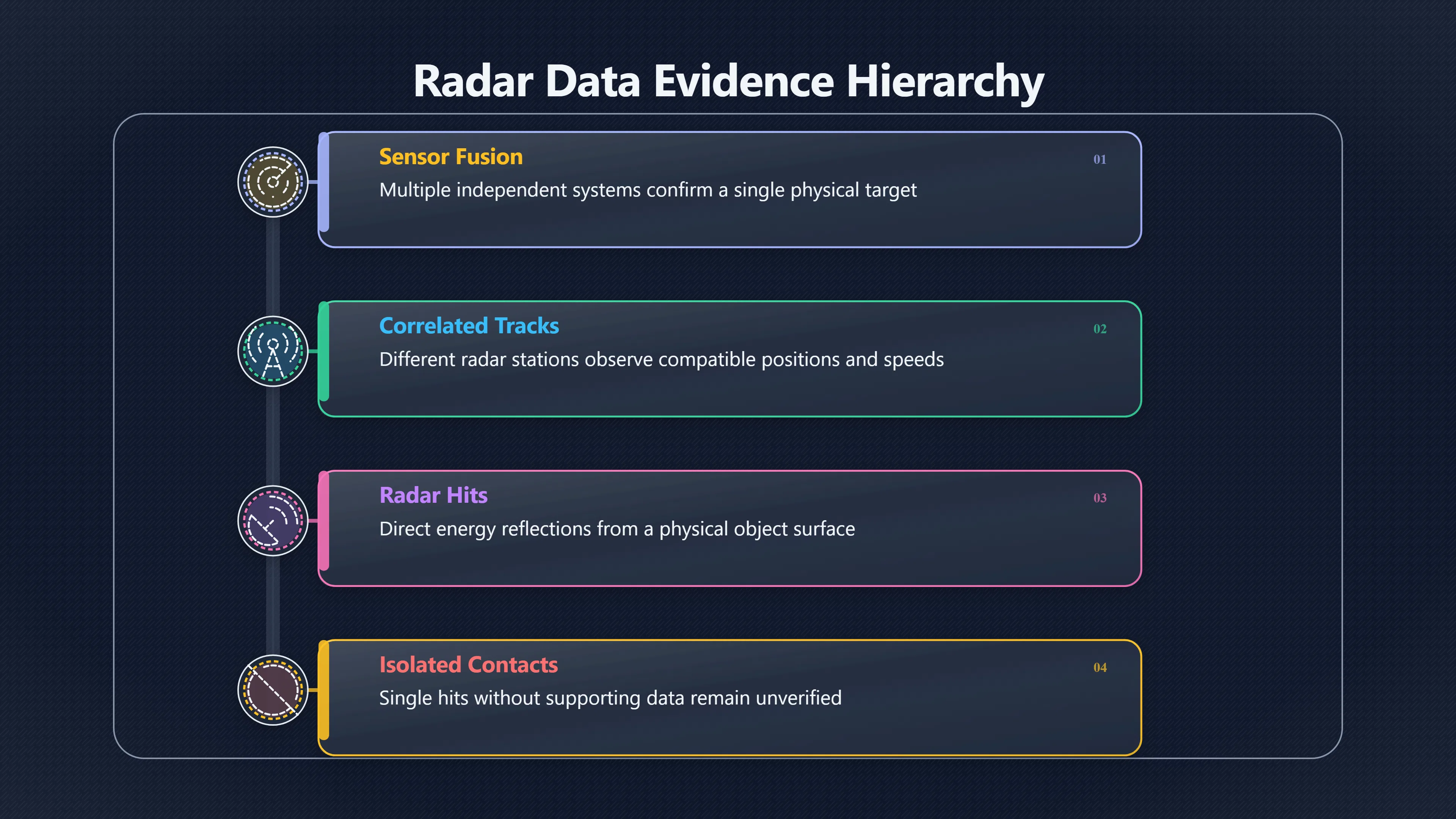
- Single-hit returns, which may be random noise or interference.
- Persistent tracks, which continue over multiple scans.
- Correlated tracks, where independent radar systems observe compatible positions.
- Sensor fusion, where radar agrees with infrared, optical or onboard aircraft systems.
The evidential value rises significantly as independent sources converge. Conversely, an isolated unexplained radar contact with no supporting information is usually regarded as insufficient for firm conclusions.
Historical reviews of military UFO investigations reached similar conclusions. Even long-running official programmes found that many unresolved cases remained unresolved because available technical information was incomplete rather than because radar had demonstrated impossible flight characteristics.[U.S. Department of War]media.defense.govDOPSR 2024 0263 AARO HISTORICAL RECORD REPORT VOLUMEDepartment of WarAARO Historical Record Report Volume 18 Mar 2024 — established Project BLUE BOOK to study UFO phenomena. Based at Wright…
The missing records in celebrity accounts
This is where celebrity UFO stories usually encounter their greatest evidential limitation.
Many well-known personalities have described unusual lights or objects, but very few cases include publicly available radar recordings, authenticated air traffic logs or preserved sensor data that researchers can independently examine.
Even when a celebrity was flying an aircraft, investigators would ideally want:
- the precise time and route;
- air traffic control communications;
- radar recordings from relevant facilities;
- weather observations;
- nearby aircraft positions;
- any onboard navigation or flight recorder information.
Without these records, later recollections cannot easily be tested against objective data.
The often-discussed association between actor and pilot Kurt Russell and the 1997 Phoenix Lights illustrates both the value and the limits of testimony. His account is notable because it potentially places an experienced pilot within a broader mass-sighting event. However, evaluating that experience still depends on contemporaneous aviation records and broader investigation rather than celebrity status alone. The witness’s fame neither validates nor invalidates the observation. It simply makes the account more widely known.
What investigators look for instead of a single radar hit
Professional investigators increasingly favour a layered approach rather than relying on one impressive-looking radar contact.
The strongest cases typically combine:
- independent eyewitnesses who reported the event before publicity spread;
- preserved radar data with known technical characteristics;
- synchronised timestamps across different systems;
- optical or infrared observations that match radar geometry;
- environmental information such as weather and astronomical conditions;
- complete metadata allowing later re-analysis.
This reflects a broader shift in scientific treatment of UAP. Rather than asking whether one instrument “proved” an extraordinary event, researchers ask whether multiple calibrated systems independently measured the same phenomenon in ways that remain mutually consistent. Recent scientific proposals for dedicated UAP observatories similarly recommend integrated networks of optical sensors, radar, radio receivers and environmental monitoring because each instrument compensates for the limitations of the others.[arXiv+2World Scientific]arxiv.orgThe Scientific Investigation of Unidentified Aerial Phenomena (UAP) Using Multimodal Ground-Based ObservatoriesMay 29, 2023…
What radar can and cannot prove
Radar can establish that a sensor detected something consistent with a physical target under specific operating conditions. It can sometimes estimate position, motion and persistence with considerable precision. It can also provide an objective record that survives long after eyewitness memories fade.
What radar cannot reliably prove on its own is the identity, origin or nature of the detected object. Apparent high speeds may reflect tracking assumptions, missing data or geometry. Unusual manoeuvres require careful analysis of raw measurements rather than display outputs or anecdotal summaries. Missing recordings, unknown system settings and incomplete chains of custody further reduce confidence in retrospective claims.
For celebrity UFO accounts, this distinction is crucial. A report becomes substantially stronger if verifiable radar records exist and can be independently analysed. In most famous cases, however, those records are unavailable, incomplete or were never preserved. As a result, radar remains one of the most valuable forms of supporting evidence in UFO investigations—but also one of the most frequently cited without the underlying data needed to resolve the case.
Amazon book picks
Further Reading
Books and field guides related to What Radar Can and Cannot Prove. Use these as the next step if you want deeper reading beyond the article.

UFOs : Generals, Pilots, and Government Officials Go on the R...
Discusses radar, pilot reports, and multi-source evidence.
eBay marketplace picks
Marketplace Samples
Live-tested eBay searches with available results related to this page.




Endnotes
1.
Source: science.nasa.gov
Link:https://science.nasa.gov/uap/
Source snippet
NASA ScienceUAP9 Jun 2022 — A study team to examine unidentified anomalous phenomena (UAPs) – that is, observations of events in the sky...
2.
Source: media.defense.gov
Title: DOPSR 2024 0263 AARO HISTORICAL RECORD REPORT VOLUME 1 2024
Link:https://media.defense.gov/2024/Mar/08/2003409233/-1/-1/0/DOPSR-2024-0263-AARO-HISTORICAL-RECORD-REPORT-VOLUME-1-2024.PDF
Source snippet
Department of WarAARO Historical Record Report Volume 18 Mar 2024 — established Project BLUE BOOK to study UFO phenomena. Based at Wright...
3.
Source: arxiv.org
Link:https://arxiv.org/abs/2404.01437
Source snippet
The Radar Ghost Dataset -- An Evaluation of Ghost Objects in Automotive Radar DataApril 1, 2024...
Published: April 1, 2024
4.
Source: arxiv.org
Link:https://arxiv.org/abs/2305.18566
Source snippet
The Scientific Investigation of Unidentified Aerial Phenomena (UAP) Using Multimodal Ground-Based ObservatoriesMay 29, 2023...
Published: May 29, 2023
5.
Source: arxiv.org
Link:https://arxiv.org/pdf/2305.18566
Source snippet
as that phenomenon described by reports of visual or instrumental observations of lights or objects in the...Read more...
6.
Source: war.gov
Title: department of defense releases the annual report on unidentified anomalous phen
Link:https://www.war.gov/News/Releases/Release/Article/3964824/department-of-defense-releases-the-annual-report-on-unidentified-anomalous-phen/
Source snippet
You can also find the report on odni.gov, and on AARO's website, aaro.mil.Read more...
7.
Source: aaro.mil
Link:https://www.aaro.mil/
Source snippet
AARO HomeUnidentified Anomalous Phenomena (UAP) means (A) airborne objects that are not immediately identifiable; (B) transmedium objects...
8.
Source: worldscientific.com
Link:https://www.worldscientific.com/doi/10.1142/S2251171723400068?srsltid=AfmBOoo-wVFjrCYaBeRkFxnDfwrj9y6PUe0lFNSeFCvts-aXOi7YjuLh
Source snippet
as that phenomenon described by reports of visual or instrumental observations of lights or objects in the sky (or near, or...Read more...
Additional References
9.
Source: wired.com
Link:https://www.wired.com/story/nasa-ufos-aliens-report-2023
Source snippet
The agency stressed the need to shift the conversation from sensationalism to science and eliminate the stigma associated with [reporting]({{ 'reporting/' | relative_url }})...
10.
Source: Wikipedia
Title: NASA Unidentified Anomalous Phenomena Independent Study Team
Link:https://en.wikipedia.org/wiki/NASA_Unidentified_Anomalous_Phenomena_Independent_Study_Team
Source snippet
NASA Unidentified Anomalous Phenomena Independent...UAPs are defined as phenomena or observations of events in the air, sea, space, a...
11.
Source: archives.gov
Title: National Archives Project BLUE BOOK
Link:https://www.archives.gov/research/military/air-force/ufos
Source snippet
National ArchivesProject BLUE BOOK - Unidentified Flying ObjectsPro-UFO researchers claim that an extraterrestrial spacecraft and its ali...
12.
Source: uapradar.com
Link:https://uapradar.com/
Source snippet
e claims with clear source labels and verification context...
13.
Source: en.wikisource.org
Title: Responses to Statement of Task
Link:https://en.wikisource.org/wiki/NASA_Unidentified_Anomalous_Phenomena%3A_Independent_Study_Team_Report/Responses_to_Statement_of_Task
Source snippet
Unidentified Anomalous Phenomena: Independent...14 Oct 2023 — The excellent resolution of NISAR will provide valuable radar data that wi...
14.
Source: Wikipedia
Title: List of reported UFO sightings
Link:https://en.wikipedia.org/wiki/List_of_reported_UFO_sightings
Source snippet
List of reported UFO sightings"UAP" is sometimes used to avoid cultural associations with UFO conspiracy theories. Shapes reported as...
16.
Source: Wikipedia
Title: Unidentified flying object
Link:https://en.wikipedia.org/wiki/Unidentified_flying_object
Source snippet
Unidentified flying objectStudies and investigations into UFO reports conducted by governments (such as Project Blue Book in the Unite...
17.
Source: youtube.com
Link:https://www.youtube.com/watch?v=bQo08JRY0iM
Source snippet
and categorizing unidentified anomalous phenomena...
18.
Source: skeptic.com
Link:https://www.skeptic.com/article/ufo-files-reveal-the-same-old-material/
Source snippet
UFO Files Reveal … the Same Old Material4 days ago — The UAP is the little dot that could be almost anything (a balloon, a drone, an airc...
Topic Tree